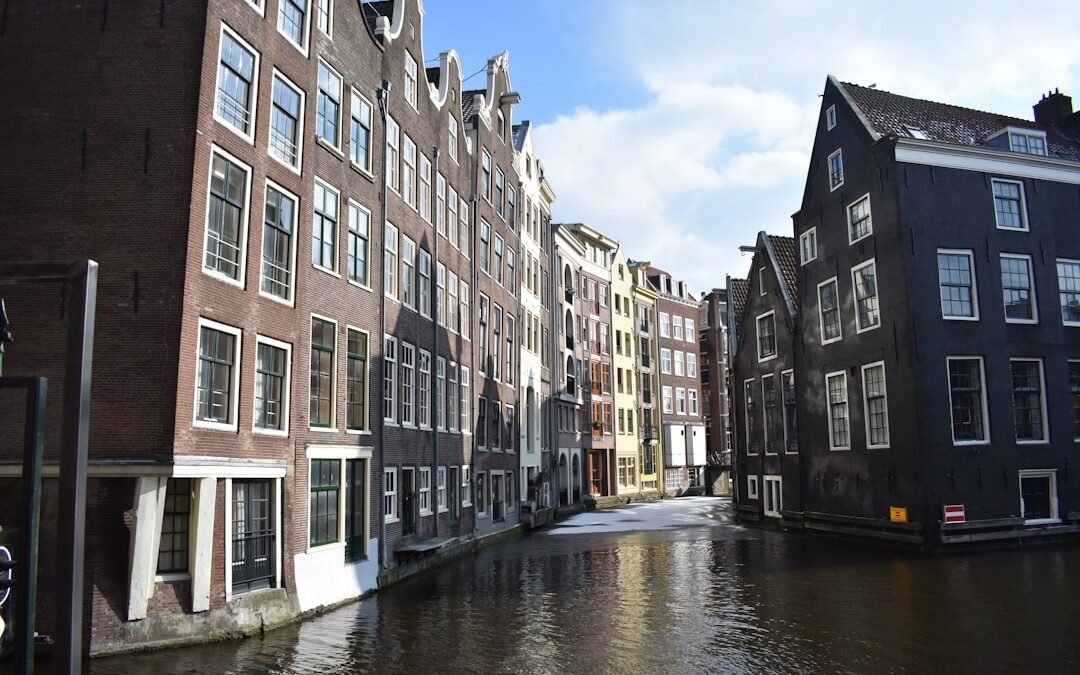
Photo by Calum Hill on Unsplash
Despite being about the size of Maryland, The Netherlands provides more food to the world than any other nation except the US. They gave us the microscope, eye-test charts, and some of the world’s greatest art including Rembrandt, Van Gogh, and iconic delftware.
Their frugality and their honest social directness is notoriously jarring to everyone but the Germans. But what do you expect from a practical, and efficient people who brought forth a country from the sea?

Like any other European ethnicity, they have their unique take on Western traditions, too. According to the Dutch, Saint Nicholas lives in Spain. And instead of elves, he leads an entourage of “six to eight black men” (David Sedaris’ words, not mine! Saint Nicholas’s helper “Black Pete” is a freed slave and the subject of ongoing controversy.)
But like its neighbors, the Netherlands faces a tidal wave of demographic change that is threatening its admirable and quirky culture beyond recognition. The Dutch (and Frisians) face a serious challenge in dealing with this radical demographic change, but it’s far from impossible!
Much like the French, Germans, and Americans, the new neighbors are overwhelmingly recent arrivals. Comparatively few hold Dutch citizenship, many are not yet integrated, and third-generation immigrants of non-European origin are rare. Remigration: the denaturalization of dual citizens, the cancellation of visas, and the deportation of illegals would massively reverse the demographic change that has been done to the Netherlands.
The Situation:
In part one, we will cover the current demographic situation in the Netherlands and familiarize ourselves with how many people are foreign-born, hold dual citizenship, or are non-European entirely. As with all our pieces, we will utilize official data collected by national statistics agencies, universities, and other established institutions where available, not because other data is not honestly acquired, but because our goal is to minimize distractions over perceived political agendas.
The latest available data from Statistics Netherlands (Centraal Bureau voor de Statistiek) reports that 4.4 million people in the Netherlands have a 1st or 2nd generation migrant background, with a total population of 17.6 million people in 2022.
Statistics Netherlands then goes on to break down these groups, stating that 2.5 million people in the Netherlands have a “non-Western” background, though their classification of which groups are non-Western is unusual. For historical reasons, Indonesians are counted as “Western,” as are the Japanese. If we properly classify these non-European groups into the ‘non-Western’ category we can more accurately see that just about 2.86 million non-Western migrants of the 1st and 2nd generation live in the Netherlands, making up 16.25% of the population.

This is far from the full story, however. Third-generation migrants, those who were born to the children of original immigrants, are a small but growing part of the Dutch population and must be mentioned. While the Dutch government classifies third-generation migrants as “Dutch” in the same way it would an ethnic Dutchman, it rather helpfully still goes through the process of tracking this population of individuals.
The Dutch government reported that in 2024, there were approximately one million third-generation immigrants, and that 551,000 have parents with a “non-European” background. This is growing rapidly. Contrast this to 2018, when there were only 120,000 third-generation migrants. Many of the hundreds of thousands of Turks, Moroccans, Surinamese, and others who live in the Netherlands arrived in the 1970s-1990s and therefore are finishing raising their (2nd generation) children. Those 2nd generation immigrants, overwhelmingly in their late 20s and early 30s, are beginning to have children.
As such, 75% of the third-generation “non-Western” population is below the age of 18 and is only just beginning to emerge as a serious demographic group, though there is one exception to this: There are several hundred thousand third-generation Indo-Dutch persons in the Netherlands, but the exact numbers of these persons are impossible to find as the Dutch state does not collect statistics on them. Some of these individuals are entirely Indonesian by descent, others are half, and many are less than 1/5th Indonesian—with Grandparents or even Great Grandparents who migrated to the Netherlands who already had an admixture of part Dutch part Asian.
We are not going to adjudicate the “Dutchness” of a group that is ill-defined, numerically unknown, and, in many cases, well-integrated. Only the Dutch nation should make this decision.
As is the case in other Western nations, the non-Western immigrants and their descendants in the Netherlands are crowded into and around the country’s major cities. 40% of the population of Rotterdam is non-Western, while both the Hague and Amsterdam have 35% non-Western populations which are rapidly growing.
These populations, being so heavily concentrated in the major cities of government, commerce, and tourism, are going to make it seem like the already large non-Western population is larger than it really is. Though none of this is to say it is small.
The Netherlands, a country of roughly 12.2 million ethnic Dutch (and Frisians) hosts over 3 million non-Western foreigners, making up roughly 18% of the population.
In total roughly 32% of the population of the Netherlands has a foreign ethnic origin once European non-Dutch are included.
This demographic transformation has thrown the Dutch into one of the most severe housing crises on the continent. The Dutch government has a system of public housing units intended for young people starting out on their own and the elderly. However, there is currently a waiting list of up to thirteen years to get a one-bedroom apartment. This is a substantial increase from 2024 when a woman running for city council explained to us in confidence that her municipality had a waiting list of nine years.
The population is growing so rapidly that the already struggling health system will take up one-quarter of Dutch employment by the year 2040. Public transportation has become too dangerous for the Dutch to utilize in many migrant-heavy areas, and is it any wonder when migrants themselves brag to the media about brandishing knives?
This demographic shift in the Netherlands has alienated the native Dutch who are relocating in droves. Roughly 460,000 Dutch live in other European Union countries. Another 70,000 Dutch have relocated to the United States and a further 100,000 plus have relocated to Canada, the United Kingdom, and Australia.
As a result of migration from Moroccan, Albanian, and South American drug cartels, The Netherlands ranks #5 in the world for the most cocaine seized. These criminals have become so brazen that they threatened the country’s future monarch, forcing H.R.H Crown Princess Catharina-Amalia to drop out of university in her own country and relocate to Spain to continue her studies.

Most concerningly for the Netherlands, and exemplified not only in the person of H.R.H Crown Princess Catharina-Amalia is the fact that most of these emigrants are young. 59% of the native Dutch who have departed the country are under the age of 30.
Furthermore, this native flight from the Netherlands has created a severe brain drain, according to the University of Groningen. Large gaps have emerged in the Dutch labor market which non-Western immigrants are unable to fill.
And it is any wonder young people are fleeing to find economic prosperity where it is denied them at home? When a longitudinal study by the University of Amsterdam found that all post-1995 immigration has had a net negative budgetary effect of some €400 billion on the Dutch state. This figure represents 73.6% of the Netherlands’s current national debt of some €524 billion.
These numbers may seem daunting, but much as we have outlined with America, Britain, France, and Australia, the Dutch have a litany of relatively simple policy options that they could use to reverse the demographic transition of their nation. Remarkably, since our first Dutch Remigration article, a litany of Remigration proposals were created in 2025. We’ll take a look at platforms presented by the Party for Freedom (PVV), Forum for Democracy (FvD), the Farmer-Citizen Movement (BBB), JA21, and Interest of the Netherlands BVNL and suggest next steps for the future of The Netherlands.