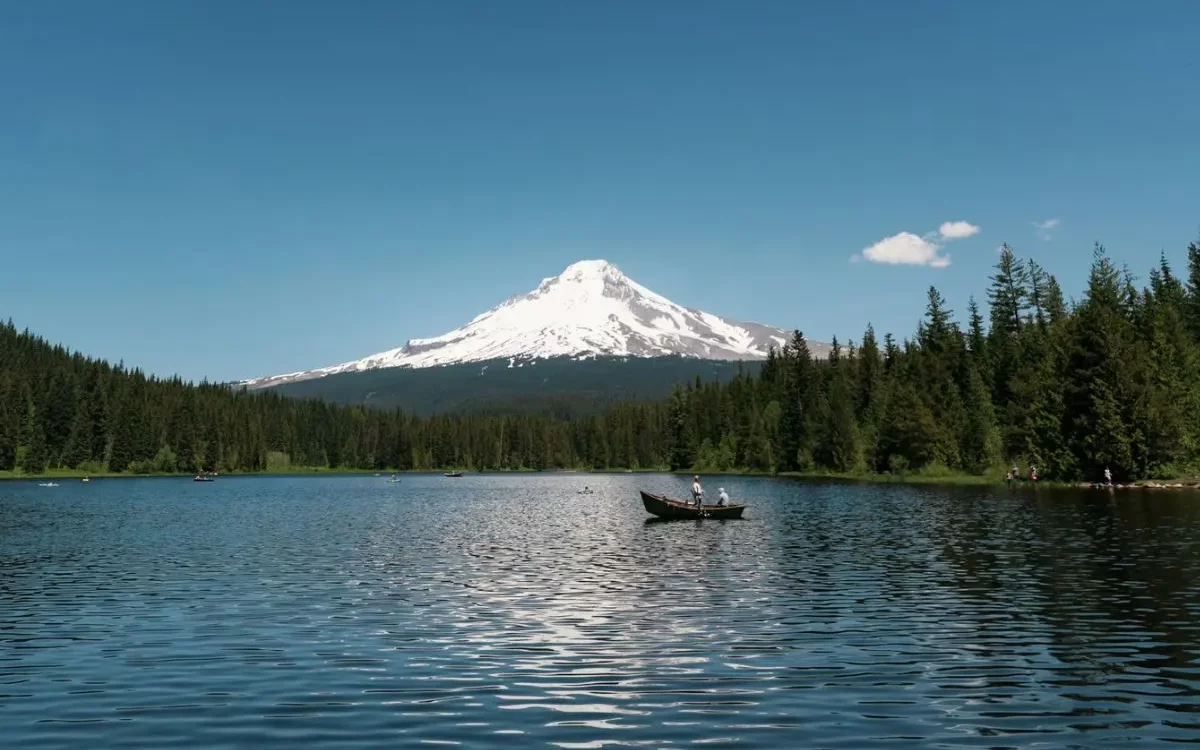
Oregon is one of the last American states that still looks, at a distance, like the country its founders intended. The Oregon Trail, the Donation Land Claim Act, the Columbia, Crater Lake, Timberline Lodge, the apple orchards, and the high desert all produced a people who thought of themselves as Western pioneers first and as a settled European American stock second. This spirit created a state that, like many others, punches far above its weight economically and culturally. Oregon hosts Nike and Phil Knight, Intel’s Hillsboro campuses, Tektronix, Columbia Sportswear, Pendleton Woolen Mills, the bottle bill, the Pinot Noir in the Willamette Valley, are not accidents of “diversity.” They are the work of a specific people in a specific place—the American people.
Oregonians have always been proud of their identity. Oregon was settled by White Americans who wished, explicitly and in their lawmaking, for an overwhelmingly Western society. For example, an 1844 territorial law, the “Lash Law” explicitly banned slavery in the state while also ordering Black residents to leave. Another 1849 law, the Territorial Exclusion Act, explicitly banned Black settlement in the state. Just before statehood, in 1850, the Federal government passed the 1850 Donation Land Claim Act which gave free land to White Americans and Native Americans while exuding all other groups. When the state’s constitution was approved in 1857, it both explicitly banned slavery in the state and explicitly banned the settlement of non-Western groups in Oregon.
Throughout its history, Oregon banned foreigners from owning land (see the 1923 Alien Land Law) and banned them from operating certain businesses in Oregonian towns and cities (see the 1923 Alien Business Restriction Law).
These laws, designed to maintain a homogeneous society, succeeded. In 1940, some 98.6% of Oregonians were non-Hispanic White Americans while just 8.3% of the population was of foreign birth. In 1960 the figure was still 97.9% White American while the foreign-born share had fallen to about 4 %. The overwhelming majority of these immigrants were aging Europeans and Canadians. Portland itself was 98.1% non-Hispanic White in 1940 and 92.2% in 1970. This was not a “diverse” society as the word is now used. It was a European, Christian, English-speaking American outpost on the Pacific, and it functioned as one of the shining examples of both American and European civilization on the North American continent.
That settlement has since been dismantled, and on purpose.
In 1960, just before the Hart-Celler Immigration and Nationality Act threw the country open to the world, Oregon’s 1.77 million people were, as aforementioned, about 98% White American and 1% African American. The Hispanic population was little more than a census rounding error, and the Asian population was roughly half a percent. The foreign-born population numbered only 71,000. The state was among the most homogeneous wealthy societies on earth. This is no longer the case.
The Hart-Celler act, family-based chain migration, the 1980 Refugee Act, the 1986 Reagan amnesty, and sixty years of legal and illegal admission of immigrants have transformed Oregon. The foreign-born share rose from 3.2% in 1970 to 4.9% in 1990, 8.5% in 2000, 9.8% in 2010, and 10% today, or about some 430,000 people. A further 212,100 residents of the state live with a foreign-born parent; and in total, White Papers estimates that 460,000 residents of the state are (both adult and child) second-generation immigrants. This means that roughly 21% of Oregon’s population is of foreign-origin, or about 890,000 people.
Directly driving this foreign-origin population growth is the Hispanic population which was under 2% of the statewide population in 1970, 3.9% in 1990, is now ranges from 14.9 to 15.5%, or roughly 630,000 to 663,000 people. The Asian population has gone from 0.5% in 1960 to more than 5% as of the 2025 American Communities Survey. Non-Hispanic White Americans, the pioneers who forged and founded Oregon for their posterity, have fallen precipitously from 97.9% in 1960 to 90.8% in 1990, 83.5% in 2000, 78.5% in 2010, to 71.7% percent in 2020. Using the latest data White Papers estimates that roughly 71% of the population of Oregon is non-Hispanic White American in 2026, or about 3.04 million people of 4.28 million residents.
Portland is still marketed as the Whitest big city in America.

The marketing is wildly out of date. While it is true that within living memory (the 1990s), Non-Hispanic Whites were 84.6% of the city, they had fallen to 76.1% in 2010, and 66.4% by 2020. Hispanics are 12-14% of the city’s population while Asians constitute roughly 8%, and Blacks and African Americans constituting about 6%. The East Side and outer East Portland absorbed most of the change.
Yet more extreme cases of the displacement of Oregonians in their state exist in the agricultural and suburban belts of the state. Woodburn, a Marion County farm town of about 30,000, was 31.4% Hispanic in 1990% and today is a majority Hispanic city with White Americans constituting just 33% of the population, down from 67.5% in the 1990s. Hermiston, a city of 20,000, is now is 54.5% Hispanic. The city of Cornelius which was 90% White American in 1980 is now just 37% White American and sports a Hispanic majority of 55.1%. Other (once) Oregonian towns such as Ontario, Milton-Freewater, Umatilla, and Independence are all between 38 and 45% Hispanic with a White American population just shy of minority status. Salem, the state capital, is about 25% Hispanic and Gresham, Portland’s large eastern suburb, is over 21% Hispanic. Hillsboro, the home of Intel, is about 26% Hispanic and less than 58% White American.
It is worth noting that these are not the historic Tejano towns of Texas or the centuries-old Hispano communities of New Mexico and Arizona. These towns and cities were ordinary American communities that received Mexican and Central American labor migration and subsequent family-based chain migration that drove the populations that descended from the pioneers into minority status.
If mass immigration after 1965 had never occurred, Oregon would still be a White American-supermajority state of a size and character recognizable to the generations that built it. Instead, nearly half of the state’s population growth since 1990 has been immigration and the children of immigrants.

One in five Oregon children now lives with at least one immigrant parent. This is replacement in real time.
The state government has not been a passive actor, either. With the passage of House Bill 2314, Oregon became the first sanctuary state in the nation in 1987 by forbidding state and local agencies from cooperating with federal immigration enforcement absent a judicial warrant. Worse still, the law was passed almost unanimously by both parties. While all Democrats voted yes in both houses of the state legislature (as a modern American political observer would expect) most Republicans also voted yes. Of the 29 Republican house members at the time, only 3 voted against it. And of the 13 Republican state senate members, only one, Senator Lenn Hannon, voted against the bill. Oregon became a sanctuary state with shockingly little official opposition.
Since then, the sanctuary statutes have been expanded such as in 2021 when the Sanctuary Promise Act was passed and banned local agencies from asking about citizenship or place of birth during routine public interactions. Other subsequent statutes expanded driver’s licenses to illegal aliens, limited information-sharing, and, in response to the Trump administration’s immigration enforcement attempts, under Governor Tina Kotek, produced an “immigrant justice package” and an order denying undercover plates to ICE.
Oregon Gov doubles down on blocking ICE from obtaining undercover license plates, defying DOJ lawsuit
DOJ officials warned that the policy directly puts ICE agents in danger.
https://t.co/dBAV1KYsSH— Katie Daviscourt 📸 (@KatieDaviscourt) June 17, 2026
Localities such as Portland and Multnomah County have layered their own sanctuary rules on top of the plethora of state actions and laws.
These policies are not the will of some abstract “nation of immigrants.” They are the practical actions of a political class that prefers new, Third World constituents to old, American ones.
As of 2026, Oregon has about 4.28 million residents who we estimate are:
- Non-Hispanic White: roughly 3.04 million, or 71%
- Hispanic (any race): about 684,000, or 16%
- Asian: 330,000 or about 5.3%
- Black and African American: 96,000 or 2.2%
- American Indian and Alaska Native: 17,000 or about 0.4%
- Two or more races and other: the remainder
The foreign-born population is 429,000 (10%), and of those some 51% are naturalized, and about 210,000 are non-citizens. The Migration Policy Institute estimated that 155,000 illegal and irregular immigrants live in the state as of mid-2023. Latin American immigrants account for 44% of the foreign-born population (Mexicans alone constitute a third of this). Asia has supplied another 30% of these immigrants, and Europe stands at less than 12%.
Historic Oregonians, the White American, small African American, and small pre-1965 Hispanic American and Native American communities that actually built the state are a fast shrinking minority and share of the electorate. The time for remigration policies is now, before the grandchildren of the current rump of Oregonians are unable to utilize the political process to maintain their sovereignty in the state and its trajectory.
We must always remember that the demographic and civic decline of Oregon, and America at large, is a policy choice a political elite have made, and is therefore one the American people can choose to reverse through popular policy. It can be reversed by the same instruments White Papers has set out for Michigan, Illinois, Texas, and the nation: mandatory removal of those with no lasting legal claim, review of fraudulent and public-charge naturalizations, visa and green-card cancellation, and a voluntary paid remigration program for the large share of post-1965 immigrants and their descendants who say they would leave if given the means and opportunity.
The first step as always is the illegal population. MPI’s 155,000 unauthorized residents, plus their minor children, are the obvious starting point. Ending welfare and public benefits for illegal aliens, imposing mandatory E-Verify, enforcing the Immigration Reform and Control Act’s employer sanctions, and requiring state and local cooperation with ICE would produce a rapid combination of self-deportation and formal removal. Oregon’s sanctuary statutes are an obstacle, and they will need to be repealed.
The second step is the legal non-citizen population which comprises some 55,000 to 57,000 people on visas and green cards. Canceling or refusing to renew those statuses, as White Papers has argued nationally, removes them without touching a single American passport and will allow a structured removal process of these immigrants and their families. Many millions of native-born Americans continue to languish without a job. Oregon nor America need a foreign-born worker population.
The third step is to look at cases of citizenship fraud within the naturalized population. White Papers has shown many times that in a normal year, 70 to 80% of legal admissions are family-based, not employment or skill-based as the popular media and politicians insist. We will continue to highlight the State Department’s 2008 refugee family DNA tests which found that only about 20% of claimed relatives were actually related to the immigrant sponsoring them to come to the United States. Furthermore, CIS data shows 53% of immigrants, including 50% of the naturalized immigrants, make use of the American welfare state, in violation of the public charge tradition and the 1996 welfare law. Moreover, USCIS’s Operation Twin Shield which uncovered fraud, crime, or national-security problems in 44% of the legal migrants they visited in the Twin Cities of Minnesota. H-1B audits have found violation rates around 20% among those investigated. And if we apply those same rates in Oregon, it is entirely within the realm of possibility that, of the 219,000 naturalized immigrants in the state, some 110,000 have a justifiable case for denaturalization on the grounds of fraud, crime, or public charge violations.