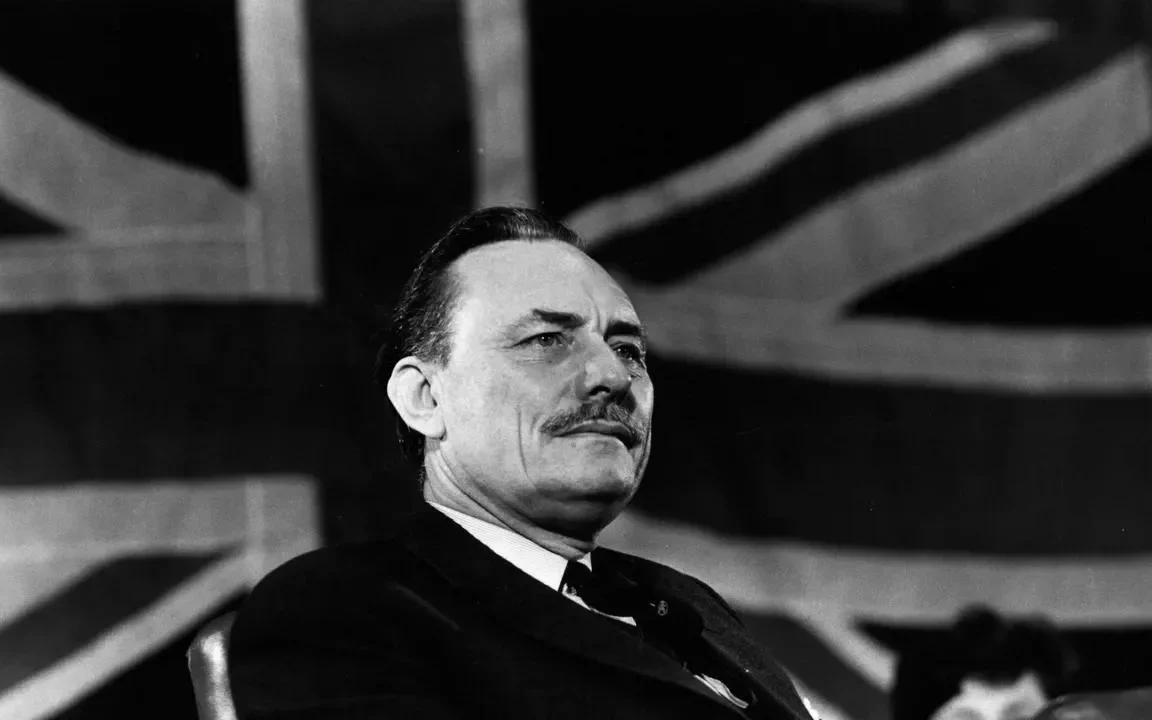
Today is the birthday of Enoch Powell, the British statesman famous for his Rivers of Blood speech.
His speech at Birmingham earned its colloquial name from this line “Like the Roman, I seem to see ‘the River Tiber foaming with much blood’.” This is a reference to the Aeneid where the hero, Aeneas consults with Cumaen Sybil, asking her what the future holds.

“Well isn’t that a bit dramatic?” you might ask? But after witnessing the attempted beheading in Belfast and unrest that followed, is this really an exaggeration?
Last Tuesday, a Sudanese migrant who had been granted asylum attempted to behead an Irishman in the street with a Stanley knife. If you can stomach it, you can see the graphic footage here.
It seems prescient then to take a somber moment to revisit Powell’s warning and notice what has in fact already come to pass so we can craft our future more responsibly.
In his speech, Powell uses vocabulary that to modern sensibilities would seem uncouth (we no longer refer to Blacks as Negroes for example—but it was the polite term in 1968). Even he recognizes that some of the statements of his constituency are impolite, but are also nonetheless genuine, honest, human concerns with a political solution. We all ought to be mature enough to look beyond antiquated language and come to grips with his prediction and what is actually going on today– the replacement of Britons with foreigners and the social turmoil that comes with it.
Powell begins:
The supreme function of statesmanship is to provide against preventable evils. In seeking to do so, it encounters obstacles which are deeply rooted in human nature.
One is that by the very order of things such evils are not demonstrable until they have occurred: at each stage in their onset there is room for doubt and for dispute whether they be real or imaginary. By the same token, they attract little attention in comparison with current troubles, which are both indisputable and pressing: whence the besetting temptation of all politics to concern itself with the immediate present at the expense of the future.
Above all, people are disposed to mistake predicting troubles for causing troubles and even for desiring troubles: “If only,” they love to think, “if only people wouldn’t talk about it, it probably wouldn’t happen.”
Perhaps this habit goes back to the primitive belief that the word and the thing, the name and the object, are identical.
At all events, the discussion of future grave but, with effort now, avoidable evils is the most unpopular and at the same time the most necessary occupation for the politician. Those who knowingly shirk it deserve, and not infrequently receive, the curses of those who come after.
To avoid naming something we’re uncomfortable with is a natural human inclination. Take the bear for example, early Germanic hunters believed that speaking the beast’s name would summon one. They used it so infrequently that they lost the word, and today, the word we use instead, bēre, literally just means “brown one.”
We do the same with migrants and crime. If you don’t speak of the crimes immigrants commit, do they exist?
Even worse, God forbid people consider why it is that in incidents of interracial violence, the perpetrator is Black and the victim is White in 85.5% of the time according to a detailed study by Rachel Morgan (2015) for the Bureau of Justice Statistics, Race and Hispanic Origin of Victims and Offenders, 2012-15.

Powell continues:
A week or two ago I fell into conversation with a constituent, a middle-aged, quite ordinary working man employed in one of our nationalised industries. After a sentence or two about the weather, he suddenly said:
“If I had the money to go, I wouldn’t stay in this country.” I made some deprecatory reply to the effect that even this government wouldn’t last for ever; but he took no notice, and continued: “I have three children, all of them been through grammar school and two of them married now, with family. I shan’t be satisfied till I have seen them all settled overseas. In this country in 15 or 20 years’ time the black man will have the whip hand over the white man.”
I can already hear the chorus of execration. How dare I say such a horrible thing? How dare I stir up trouble and inflame feelings by repeating such a conversation?
The answer is that I do not have the right not to do so. Here is a decent, ordinary fellow Englishman, who in broad daylight in my own town says to me, his Member of Parliament, that his country will not be worth living in for his children.
This is true. Today, Enoch Powell would probably be worried about being imprisoned for incitement of racial hatred. In recent years, the UK has banned people from entering who even mention demographics at all such as the Dutch political commentator Eva Vlardingerbroek.
Moreover, although perhaps crudely put, his constituent has been proven right in the sense that anti-White discrimination is prevalent (Jeremy Carl’s The Unprotected Class: How Anti-White Racism Is Tearing America Apart provides an incredible overview of this modern development, but for many, reading headlines is enough.) One need only to look at South Africa to see what waits for us when Europeans become a minority in their own countries.
Nonetheless, regardless of social propriety, as one of the last decent and responsible statesmen, Powell presses on:
I simply do not have the right to shrug my shoulders and think about something else. What he is saying, thousands and hundreds of thousands are saying and thinking – not throughout Great Britain, perhaps, but in the areas that are already undergoing the total transformation to which there is no parallel in a thousand years of English history.
In 15 or 20 years, on present trends, there will be in this country three and a half million Commonwealth immigrants and their descendants. That is not my figure. That is the official figure given to parliament by the spokesman of the Registrar General’s Office.
The most recent figure from the UK Office for National Statistics is actually 13.1 million.
There is no comparable official figure for the year 2000, but it must be in the region of five to seven million, approximately one-tenth of the whole population, and approaching that of Greater London. Of course, it will not be evenly distributed from Margate to Aberystwyth and from Penzance to Aberdeen. Whole areas, towns and parts of towns across England will be occupied by sections of the immigrant and immigrant-descended population.
While Greater London is still majority White British as of the last census at 53.8%, Manchester’s White British population is only 49%, Luton’s is 45.2%, Birmingham is 48.6%, and Slough, next door to Windsor Castle, is only 36% White British.
As time goes on, the proportion of this total who are immigrant descendants, those born in England, who arrived here by exactly the same route as the rest of us, will rapidly increase. Already by 1985 the native-born would constitute the majority. It is this fact which creates the extreme urgency of action now, of just that kind of action which is hardest for politicians to take, action where the difficulties lie in the present but the evils to be prevented or minimised lie several parliaments ahead.
These evils to be prevented or minimized include the aforementioned beheading attempt, or the murder of Henry Nowak for example.
Powell spends some time discussing the specific numbers of legal immigrants entering the country and then describes his solution:
I turn to re-emigration. If all immigration ended tomorrow, the rate of growth of the immigrant and immigrant-descended population would be substantially reduced, but the prospective size of this element in the population would still leave the basic character of the national danger unaffected. This can only be tackled while a considerable proportion of the total still comprises persons who entered this country during the last ten years or so.
Hence the urgency of implementing now the second element of the Conservative Party’s policy: the encouragement of re-emigration.
Only 58 years later are we finally seeing the popularization and development of the idea of Remigration.
Nobody can make an estimate of the numbers which, with generous assistance, would choose either to return to their countries of origin or to go to other countries anxious to receive the manpower and the skills they represent.
Nobody knows, because no such policy has yet been attempted. I can only say that, even immigrants in my own constituency from time to time come to me, asking if I can find them assistance to return home. If such a policy were adopted and pursued with the determination which the gravity of the alternative justifies, the resultant outflow could appreciably alter the prospects.
Today, using current polling data, we estimate that roughly half of foreign born would voluntarily remigrate if they had the resources to do so (and we propose how here.) For example, a Word on the Curb survey found that 66% of ethnically non-British aged 16-34 in the UK were considering or actively planning on leaving.