All Americans should be alarmed by the scale and character of post-1965 legal mass immigration. After two generations of closed borders and cultural cohesion which helped to turn America into the world’s leading superpower, our borders were opened again in 1965 by the Hart-Celler Act. Since then, our country has become progressively more diverse and therefore less American. While massive illegal immigration has imposed social and economic costs, deliberate, post-1965 legal mass immigration has played a significant role in the rapid demographic dispossession of Americans, wage stagnation for native workers, fiscal strain on our welfare programs, and a cultural erosion of the American way of life. We need a correction.
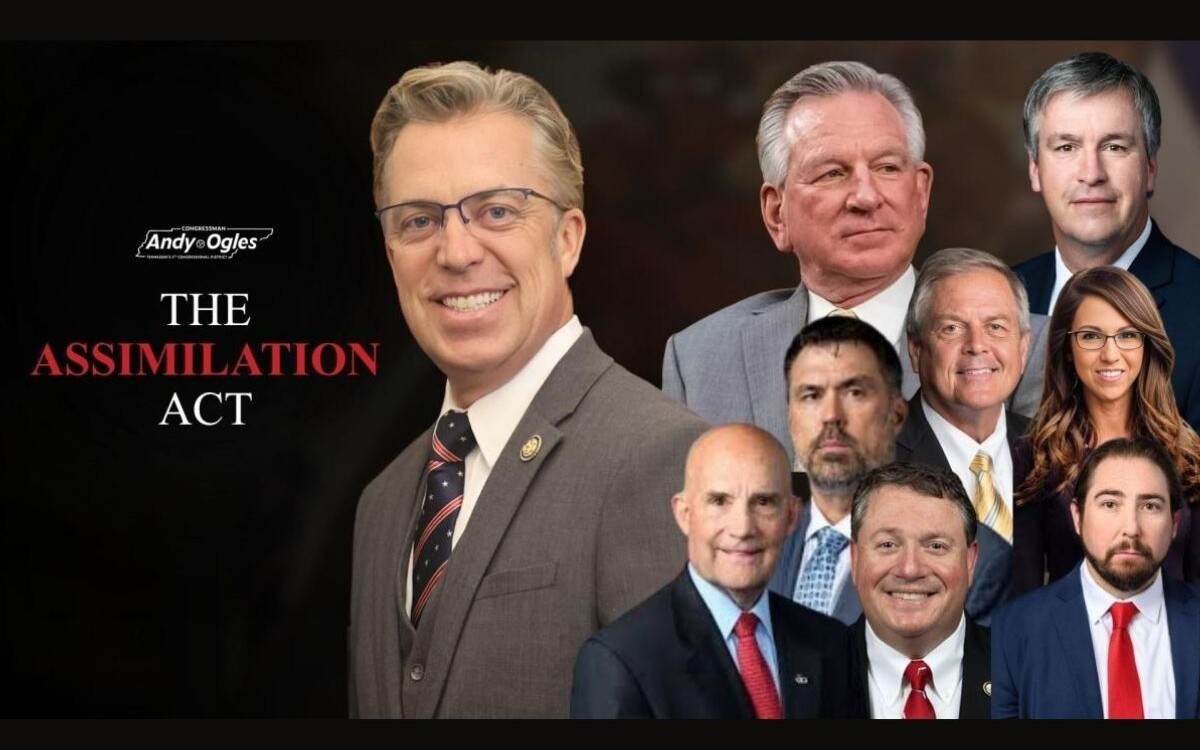
Tennessee representative Andy Ogles’ newly introduced ASSIMILATION Act (formally the “American System for Sustainable Immigration and Mass Immigration Limitations Achieved Through Imposing Oversight Nationally Act”) is, in our opinion, this substantive and long-overdue corrective.
Introduced by Sen. Tommy Tuberville (R-Alabama) and Rep. Andy Ogles (R-Tennessee) on May 14, 2026, the bill explicitly targets the Hart-Celler framework (the 1965 Immigration and Nationality Act Amendments) that shifted U.S. policy away from national-origins preservation and prioritized chain migration and engineered diversity.

The legislation’s structure and provisions align closely with core America First priorities: it ends exponential family-chain migration, eliminates the anti-assimilation diversity lottery, imposes a national-interest gate that includes cultural considerations, and raises concrete assimilation and self-sufficiency bars. The Assimilation Act represents the strongest congressional attempt in generations to halt mass immigration and to replace it with an immigration system focused upon quality and cultural compatibility.
Findings and Purposes (Sections 101–102)
Section 101 (Findings) states that the 1965 Amendments “replaced national origins quotas with a preference system prioritizing extended family-based immigration over national interest.” It finds this produced “unprecedented levels of chain migration,” created the diversity visa lottery, increased overall immigration, strained public resources, suppressed wages, and “tested the ability of the people of the United States to promote assimilation and social cohesion.”
This finding is a refreshingly honest assessment from two members of Congress. For more context, between 1921, when the Emergency Quota Act was introduced to curtail mass immigration from Europe, and 1965, when the Hart-Celler Act was passed, legal immigration to the United States averaged 213,000 individuals per year—a significant decrease from the 850,000 to 2.1 million that had arrived every year since the 1890s. As a result of this 44-years of restriction, the foreign-born population of the United States plummeted from nearly 14% in 1920 to about 5.4% by 1960. The overall population of immigrants during that time declined from 14 million in 1920 to 9.7 million in 1960. America became substantially more American through a half-century of closed borders and stringent integration of the descendants of the early 20th century immigrants. The 1965 Hart-Celler Act erased that progress.
Between 1965, when Hart-Celler passed and 2024 (just before Trump returned to office), legal immigration to the United States averaged 808,000 new permanent residents per year. Between 1990 and 2024, specifically new permanent legal immigrants averaged 1.02 million per year. By December of 2024, the foreign-born population of the United States exceeded 53.3 million people composing 16% of the population—the highest share of foreigners in American history by far. This cannot be allowed to continue, and that is what the Assimilation Act appears to recognize.
Section 102 (Purposes) aims:
“(1) to ensure immigration policy advances the national interest by establishing a universal national interest standard… and
(2) to revise and repeal the central framework established by the Hart-Celler Act by replacing family-chain and lottery-based admissions with a merit-based system that prioritizes economic self-sufficiency, cultural assimilation, and the protection of United States workers.”
This is the bill’s north star. It rejects the post-1965 default of high-volume, low-scrutiny immigration in favor of deliberate selection for net benefit—including cultural assimilation.
National Interest Standard (Section 104)
The bill adds a new subsection to 8 U.S.C. 1101 requiring that “An alien’s admission, classification, employment, or proposed endeavor shall be deemed to be in the national interest only if such alien establishes, by a preponderance of objective evidence, that such admission, classification, employment, or proposed endeavor is expected to produce a material prospective public benefit for the United States.”
Public benefit may include significant contributions to “economic, cultural, educational, scientific, technological, health, foreign-policy, or security interests.” Determinations cannot rest on private interest, unsupported assertions, or speculation.
This is one of the bill’s strongest America First features. Rather than permitting the mass entry of non-productive and culturally alien immigrants, the Assimilation Act creates a framework where a rejection of admission is presumed, and the burden of proof lies upon the immigrant to prove they can contribute to the national interest of the United States. This framework very directly counters the post-1965 inertia of admitting large numbers simply because of family ties or the ability to win a diversity visa or H-1B visa lottery spot. The Assimilation Act will, in essence, stop the mass importation of low-trust tribal and third world immigrants (think entire Somali villages moving to Minnesota) and instead create an environment where to admit even one immigrant will require remarkable scrutiny of their ability, background, and skill set. Moreover, the use of the term “public benefit” means that the employment of masses of legal immigrants by American corporations would be heavily curtailed.
Family-Sponsored Immigration Reform (Section 201)
This section dramatically narrows chain migration:
- Immediate relatives are limited to “spouses and unmarried children under 18 years of age of a citizen of the United States.”
- Lawful permanent residents may sponsor only “spouses or children under 18 years of age.”
- Parents of U.S. citizens aged 21+ receive a new temporary non-immigrant classification (W visa): initial 5-year admission, extendable only while the sponsor resides in the U.S.; ineligible for employment or any federal/state/local public benefits; sponsor must be financially responsible; requires proof of health insurance imposing no government cost; does not confer immigrant status or adjustment eligibility.
- Worldwide family-sponsored level capped at 88,000.
This is perhaps the most important section of the bill. Currently, family-based immigration is responsible for 65% to 78% of immigrant admissions to the United States every year. Each year more than 750,000 immigrants are admitted to this country on the basis of family ties and more than 75% of those admissions are the family members of other immigrants, not of Americans. Furthermore, current immigrants can sponsor adult children, the parents, their siblings, and those individuals can then in turn sponsor their own family members. It is a massive ‘chain’ that pulls entire Pakistani, Mexican, Somali, and other third world villages and towns into the United States to resettle en masse. The Assimilation Act puts an end to this.
By limiting family admission to spouses and unmarried children under the age of 18, the Assimilation Act will effectively end chain-migration from the third world. It will also heavily curtail the number of second-generation immigrants born in the United States through limiting the immigration of the children of immigrants to unmarried minors. It’s a fantastic provision.
White Papers estimates that the implementation of Section 201 would lower legal immigration to the United States by about 450,000 individuals a year and cut family-based immigration by 55% in the first several years of implementation. The legislation would also significantly curtail the number of naturalizations given that it does not allow most family members the ability to adjust their visa once the sponsoring family member departs or is no longer able to financially support them.
Elimination of Diversity Immigrant Category (Section 202)
The bill strikes section 203(c) of the INA (the diversity visa lottery) entirely. It applies to new petitions; prior selections lose eligibility post-enactment.
Americans have long criticized the diversity lottery as an explicit mechanism to increase immigration from underrepresented (read third-world) regions after the 1965 shift. The Diversity Lottery essentially functions as a form of demographic engineering. It pulls the most disparate cultures and peoples from around the globe to the United States for no other reason than the crazed idea that “diversity” is an inherent good. The diversity lottery’s elimination through the Assimilation Act would serve as a symbolic and practical halt to replacement-level demographic change. It would assert the precedent in law that America is not some place where anyone can show up and “become an American. It would lower legal immigration by 50,000 people per year. As a result, there will be fewer second-generation immigrant children in the United States that Americans are forced to pretend are just as American as we are.
Employment-Based Immigration and H-1B Reforms (Sections 203–204)
Employment-based immigration in the Assimilation Act would be capped at 140,000 visas annually and subjected to a rigorous national-interest certification. This is a significant decline from the 200,000 employment-based visas that the United States issues every year. In other words, it would require American companies to hire more Americans! Additionally, the employment-based applicants must satisfy at least one presumptive positive factor and rebut all presumptive negative factors.
Presumptive positive factors include high compensation (90th percentile), work in designated national-interest/shortage occupations at the 75th percentile or commitment to shortage fields, strategic federal support, extraordinary ability, or entrepreneurship creating U.S. jobs.
Presumptive negative factors (must be rebutted) include sub-median compensation, limited English proficiency (below B1 on the CEFR scale, with limited exceptions), serious employer labor noncompliance, or failure to show self-sufficiency without means-tested benefits.
Priority would shift from a lottery system to one based upon compensation and ability. The H-1B reforms in the legislation impose a 200% of median wage floor, a 50,000 annual visa cap, and most substantially a limitation of the visa to 3 years without the ability to renew the H1B visa. This means the immigrant MUST depart the United States after three years and will not be considered for an adjustment to permanent residency for 2 years—two years in which they must live outside of the United States.
This section all but eliminates the H-1B-to-Green-Card pipeline. A huge win for American workers and the American people.
However, 140,000 employment-based slots plus other categories still constitute significant annual legal immigration. 140,000 immigrants who would be allowed to bring their spouses and children under 18 into the United States. Furthermore, any children born to these workers while they live in the country would become American citizens. This is quite problematic.
We would suggest the addition of a provision that explicitly defines employment-based workers similarly to tourists, diplomats, or other classes of immigrant whose children are not eligible for birthright citizenship. This will largely cut off the legal anchor-baby pipeline.
Additional Provisions and Enforcement
The bill does much more to limit legal immigration. The legislation permanently strengthens the public-charge rules so that legal immigrants who would need or who in fact use the welfare state would be removed from the country or never admitted in the first place. The legislation mandates nationwide E-Verify to make illegal aliens largely unemployable. It adds penalties for visa overstays and unlawful presence, reforms asylum and parole, and revises naturalization standards (including references in surrounding materials to longer residency expectations and stricter good-moral-character assessments). Press materials associated with the bill also reference ending birthright citizenship incentives and a 10-year path in some contexts. These are fantastic America First provisions.
These measures close loopholes that patriots have long argued facilitated abuse and reduced incentives for genuine assimilation. Mandatory E-Verify and overstay penalties are practical enforcement tools long demanded by immigration-restrictionists. Raising the naturalization bar aligns with requiring demonstrated commitment rather than automatic or easy citizenship.
Our Overall Assessment:
The ASSIMILATION Act is a serious piece of pro-American legislation that seeks to repudiate the Hart-Celler experiment, ends chain migration’s multiplier effect on mass immigration, kills the diversity lottery, and installs a national-interest filter that includes cultural assimilation and economic self-sufficiency. For any American concerned that decades of high legal immigration have changed the country’s fundamental character faster than assimilation could occur, this legislation offers a meaningful restoration of popular control over who can be a part of our national community and what the future population of the United States will look like.
Pieces of legislation like the Assimilation Act are a crucial first step towards our ultimate goal of preserving and strengthening the demography of the American people. We cannot achieve remigration without first massively restricting and reorienting how our immigration system works and who exactly it admits into our country.