January 27, 2026, European Commission President Ursula von der Leyen stood in New Delhi and declared the conclusion of negotiations for a landmark Free Trade Agreement (FTA) with India, declaring it to be the “mother of all deals” in a way noticeably reflective of the speech patterns of American president Donald Trump. This pact, the largest ever for both the EU and India, promises to slash tariffs on the vast majority of traded goods, boost bilateral commerce currently valued at around €180 billion, and create new opportunities in a combined market representing roughly a quarter of global GDP and nearly two billion people. All of these things sound great, but the real consequences are not economic. They are social. The European Union is opening yet more avenues of mass immigration to the continent, and they appear to be doing so in order to directly oppose Trump’s brand of national populism and to disenfranchise the rapidly-growing nationalist voter base within Europe.
Public speeches and the nice, formal official statements emphasize doubling EU goods exports to India by 2032 and near-universal liberalization on the Indian side for EU imports (99%+ of tariff lines by value in many projections). But the migration aspect of the deal is being swept out of the public spotlight.
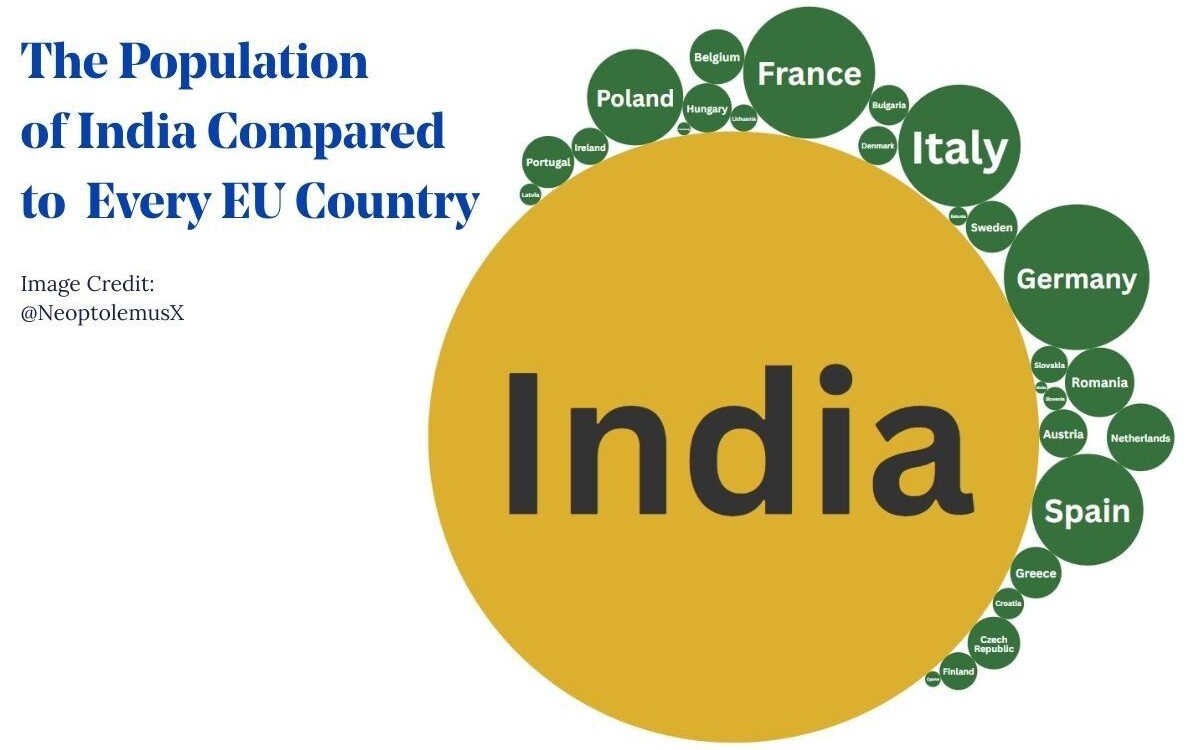
At face value, this is classic trade liberalization. The parties involved believe in the dogma of mutual gains from comparative advantage, supply chain diversification away from over-reliance on China, and strengthened ties between the world’s largest democracy and the EU bloc. Yet the “Comprehensive Framework for Cooperation on Mobility” and the longstanding EU-India Common Agenda on Migration and Mobility (CAMM, formalized in 2016) is the most consequential aspect of the trade deal. This FTA is not merely a goods-and-services deal. It is a structured pathway for significantly expanded movement of Indian nationals, students, researchers, professionals, and “skilled workers” into Europe. This mobility (mass migration) component transforms the FTA from an economic agreement into a high-stakes demographic gamble. India’s population exceeds the EU’s by a factor of roughly 3.2x and India produces millions of university graduates annually. India can supply endless low-wage labor that will undermine the already unstable European job market and lock another generation of Europeans out of the prosperity that is their birthright. As it stands, youth unemployment in the European Union is at 15%. Just shy of three million young Europeans are without stable employment.
This is great for India, of course. While young Europeans languish in a sclerotic job market, India is going to find yet another destination for its 45+ million surplus males. India is eager to send these men abroad not only because it increases domestic social stability but also because India is the largest recipient of remittances globally. By growing its take in remittances, India can fuel domestic consumer spending. And these remittances are at record levels. In 2025, India received more than $135.4 billion in remittances, a 14% increase in remittances from 2024. India sees the European Union as the next remittances frontier.
That frontier is being opened by the “Comprehensive Framework for Cooperation on Mobility” which operationalizes and expands the 2016 Common Agenda on Migration and Mobility. Key elements include:
- Simplified and fast-tracked visa procedures for students, researchers, and skilled professionals
- Potential removal or easing of quotas on Indian students, with intra-EU mobility (students able to move between member states more freely).
- Faster processing targets (e.g., 90% of student/researcher visa applications within 30 days in some proposals).
- Extended post-study work rights (reports suggest increasing from 2 to 3 years or more in certain contexts).
- Enhanced recognition of Indian qualifications, thus opening more sectors of the European economy to Indian laborers.
- Provisions for temporary entry of business visitors, intra-corporate transferees (ICTs), and professionals in Mode 4 services trade (movement of natural persons).
- Establishment of facilitation mechanisms, such as a European Legal Gateway Office in New Delhi.
These measures will super-charge existing Indian immigration trends to Europe. In recent years, Indians have been among the top recipients of Schengen visas (over 1 million applications in 2024) and residence permits in the EU. Germany, Ireland, Poland, and others have seen rising inflows of Indian students and workers, particularly in IT, healthcare, engineering, and care sectors. The EU Blue Card (for highly skilled) already favors Indians in some statistics.
With barriers lowered, faster visas, longer stays, credential recognition, and intra-EU movement, the agreement will facilitate hundreds of thousands to millions of additional entries per year. Our European political class laments its aging population and labor shortage while taking no serious domestic effort to fix these ills. Instead, it provides an easy opportunity to promote replacement migration.
So culturally, what sort of replacement are Europeans getting? For starters, the Indian view of women is not compatible with that of men in Western Civilization. There are more than 95 million child brides in India, with some reports showing that more than 12 million girls under the age of 10 are “married” to adult men. India is a global fraud hub, a global human trafficking hub, a global gang rape hub, and of domestic violence against women (38% of Indian men admit to being abusers in surveys). Indians are also highly sectarian and engage in mob violence against competing groups. One need only look at the 2022 Leicester riots in the United Kingdom between Muslims and Indians to see what the future of much of Europe will become if the already-disastrous Muslim mass migration is mixed with Indian mass immigration.