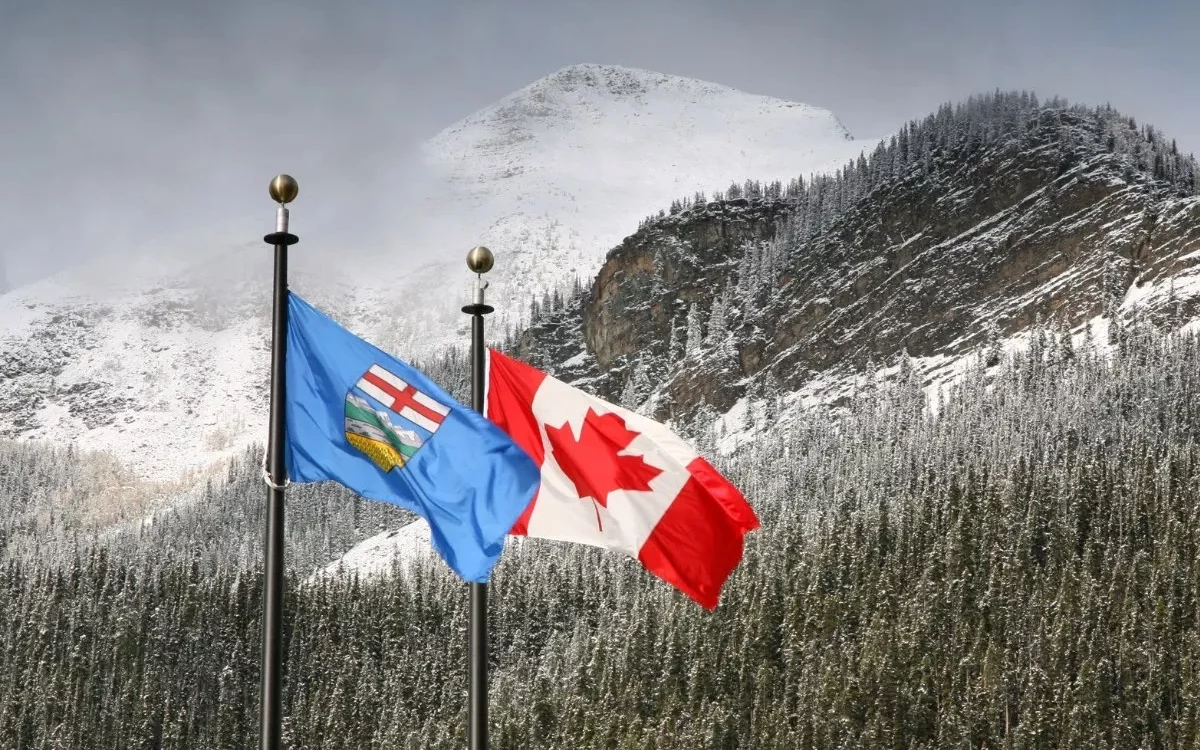
Canada’s wealthiest and most developed province is cruising rather quickly towards independence, at least rhetorically. The Provincial government of United Conservative Party Premier Danielle Smith has lowered the number of signatures required for independence advocates to force a referendum on the issue while Smith herself has said that Albertans are deeply discontented with the Canadian Confederation and its current constitutional structure.

Numerous polls in May of 2025 showed that support for separation from Canada has risen as high as 45% (at times) and a recent poll from September of 2025 showed the pro-independence Republican Party of Alberta garnering roughly 11% in the event of an election.
The reasons for these growing sentiments are varied and range from a deep distaste over Canada’s transfer system (wealthy, productive provinces’ tax money extracted to fund welfare in other provinces) and of course, immigration.
In the National Post of Canada, an Alberta columnist who doesn’t think separatism has much of a chance (despite his “near-total sympathy with most of Alberta’s grievances against Canada”) explains what some of these are:
he very constitution of the country is explicitly rigged to diminish our electoral and senatorial power. Our heavy funding of the rest of Confederation seems to earn us nothing but contempt from central Canada. I don’t have major complaints about explicit fiscal equalization between provinces per se, apart from the unceasing ad-hoc updates, but equalization is just the questionably necessary top layer of a cake.
Other provinces’ economies are all to some degree engineered around employment insurance, and around contrived seasonal industries that wink in and out of existence to allow for the hoovering of implicit labour subsidies from the federation. And unlike most of what the species calls “insurance,” eligibility to collect is lowered for the regions that use EI inveterately, not raised. The long-term effects of this haven’t been good for anybody.
Alberta’s contributions to the Canada Pension Plan are also, as the recent controversy over a project for an Alberta Pension Plan showed, enormously disproportionate. The most important source of Alberta’s relative wealth is its oil and gas, and perhaps the rest of Confederation is now prepared to stop treating this industry as a despicable moral poison. But what the RoC certainly won’t stop doing is dismissing Alberta hydrocarbons as a lucky endowment from heaven to which the province has no legitimate moral entitlement — unlike, say, nickel mines, or ocean fisheries, or hydropower, or potash and uranium, or old-growth forests and coastlines. [Links added]
Coastlines are something Alberta definitely lacks: it’s due north of Montana:

Polling from October of 2025 showed that 56% of Canadians feel there are too many immigrants in Canada while data published by the Canadian government in September of 2024 showed that among Albertans 56% felt there were too many immigrants in their province and just 7% felt there were too few. 63% of Canadians feel there are too many permanent immigrants in their country while about half of Canadians feel their government is admitting too many refugees and asylum seekers. In all of these cases the figures are higher in Alberta than in any other province safe for the rapidly changing Ontario.
The message is quite clear, Albertans are unhappy with the status quo in Canada. Yet, independence will not resolve these issues if it is not consciously pro-Canadian or in this case pro-Albertan. An independence movement rooted in post-war liberalism—which includes a dedicated to multiculturalism—will see Alberta created as just another rootless cosmopolitan country on the world stage. One whose native population of Westerners is rapidly being shuffled out the door in favor of disparate Third Worlders. In other words, not substantially different from the situation in Alberta right now.
Between 1941 and 2021 Alberta’s population of White/European Canadians (the country’s foundational stock) declined from roughly 96% of the province’s population to about 65.4% of the population. Projections provided by the Canadian government estimate that White/European Canadians will be a minority in the province by 2041. The same elite that have advocated for and enabled this radical demographic transformation are the same elite that would be entrenched in a newly independent Alberta. Nothing would change.
Instead of pouring their energies into a sovereignty movement that is unlikely to succeed and even if it does unlikely to make demographics better, Albertans need to redirect the clear energy they exhibit for politics and begin to push for a reversal of the Great Replacement in their province. They could advocate for powers similar to Quebec and thus enable the Albertan government to curtail the number of new economic migrants and Albertans could and must begin to actively campaign against the Great Replacement in the same way so many are currently campaigning for independence.
There will be no Alberta if there are no Canadians, no Albertans, left to inhabit it.