Trump went on to keep his promise of a Muslim travel ban—at least partially—on January 27, 2017, with Executive Order 13769 Protecting the Nation From Foreign Terrorist Entry Into the United States. This was actually quite limited, banning immigration from certain terrorist-producing Muslim countries.
This was almost immediately attacked by lawfare—and disloyal judges who would issue “national injunctions” enjoining the President (and the entire Federal Government) from Protecting the Nation From Foreign Terrorist Entry because that might be racist, somehow.
One of these was Hawaiian Judge Derrick Kahala Watson, pictured, of whom then-Attorney General Jeff Sessions said
“I really am amazed that a judge sitting on an island in the Pacific can issue an order that stops the president of the United States from what appears to be clearly his statutory and constitutional power.”
Watson, who blocked the Travel Ban didn’t just look at the language of the Executive Order, he was using things he had found on the Internet, or read in the papers, that Trump advisors had been quoted as saying in his decision. Judges just don’t do that. They’re supposed to read what’s in a law or Executive Order, to see if that’s Constitutional—they’re not allowed to go fishing in the newspapers for evidence, because what is in the newspapers is not evidence.
It’s not just me who thinks that—notable Never Trumper and neoconservative David Frum also said so, in the Atlantic Monthly.
See
The Dangerous Precedent Set by Judicial Attacks on Trump’s Travel Ban
Judge Derrick Watson’s imaginative reasoning asserts a new power to disregard formal law if the president’s words create a basis for mistrusting his motives.
By David Frum, March 16, 2017
Here’s me writing about it at VDARE
Of course, 15 months later, I was able to write Supreme Court Upholds Travel Ban, Shows Various Judges Who Attacked It WERE Crazy, June 26, 2018, after the Supreme Court proved to not be crazy…by a vote of 5-4.
By the way, countries affected by the original Travel Ban were Iraq, Syria, Iran, Libya, Somalia, Sudan and Yemen, but none of those countries were actually named in the Executive Order. Instead the order looks like this:
I hereby proclaim that the immigrant and nonimmigrant entry into the United States of aliens from countries referred to in section 217(a)(12) of the INA, 8 U.S.C. 1187(a)(12), would be detrimental to the interests of the United States, and I hereby suspend entry into the United States, as immigrants and nonimmigrants, of such persons for 90 days from the date of this order (excluding those foreign nationals traveling on diplomatic visas, North Atlantic Treaty Organization visas, C-2 visas for travel to the United Nations, and G-1, G-2, G-3, and G-4 visas).
Trump, as I noted in January 2017, was using the same list as used by the Obama Administration in 2011 during some major ISIS troubles—and terrorism in Kentucky—to pause refugee admissions for six months. Obama, when the Travel Ban was announced in 2017, said that he was “heartened” by protests against it—something that had never occurred when he did it.
My take at the time was that I thought Obama’s defenders feel that it’s the same as his “opposition” to gay marriage when he was trying to get elected in 2008—he may have banned Muslim immigrants from ISIS-type countries in 2011, when he was facing reelection but he didn’t really mean it.
Trump, by contrast, really wanted to protect America, and there’s a lot of opposition to that. Joe Biden, one the people who did not want to protect America, revoked Trump’s “Travel Ban” on Day One of his Administration.
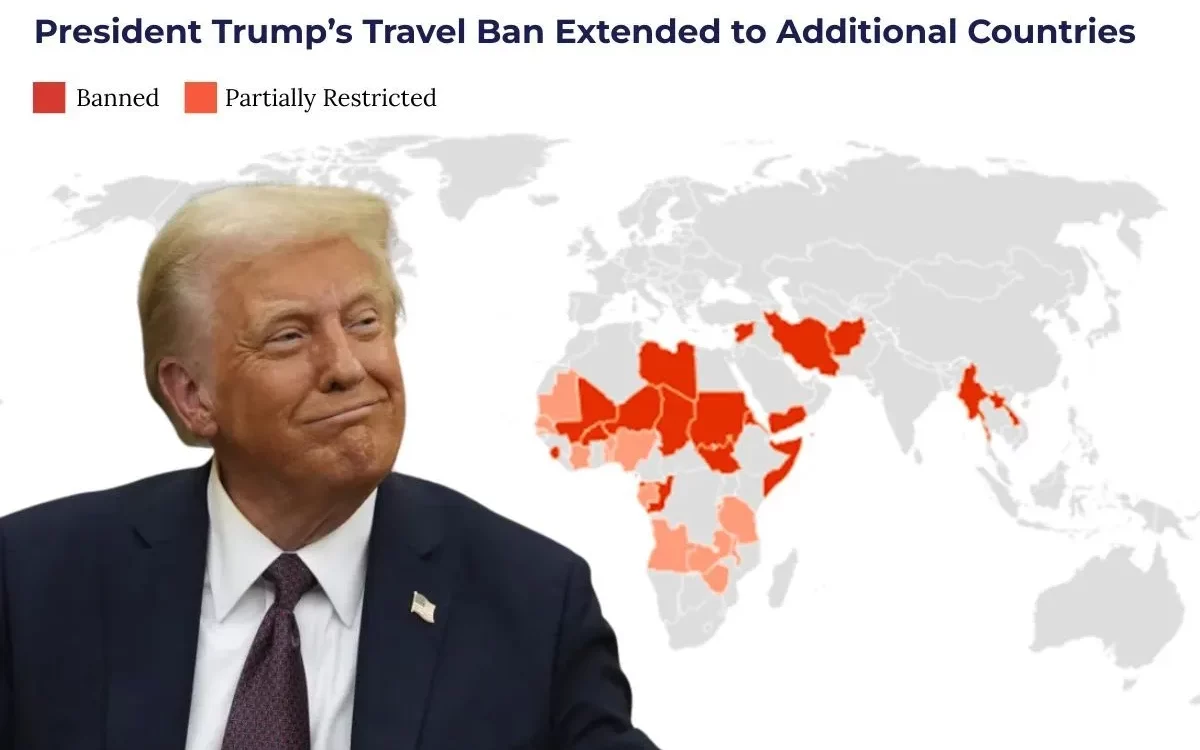
However, Trump is back, and as an early Christmas present to opponents of mass Third World immigration, he has issued a new ban: Fact Sheet: President Donald J. Trump Further Restricts and Limits the Entry of Foreign Nationals to Protect the Security of the United States, December 16, 2025
Here’s a sample:
STRENGTHENING NATIONAL SECURITY THROUGH COMMON SENSE RESTRICTIONS BASED ON DATA: Today, President Donald J. Trump signed a Proclamation expanding and strengthening entry restrictions on nationals from countries with demonstrated, persistent, and severe deficiencies in screening, vetting, and information-sharing to protect the Nation from national security and public safety threats.
- The Proclamation continues the full restrictions and entry limitations of nationals from the original 12 high-risk countries established under Proclamation 10949: Afghanistan, Burma, Chad, Republic of the Congo, Equatorial Guinea, Eritrea, Haiti, Iran, Libya, Somalia, Sudan, and Yemen.
- It adds full restrictions and entry limitations on 5 additional countries based on recent analysis: Burkina Faso, Mali, Niger, South Sudan, and Syria.
- It also adds full restrictions and entry limitations on individuals holding Palestinian-Authority-issued travel documents.
- It imposes full restrictions and entry limitations on 2 countries that were previously subject to partial restrictions: Laos and Sierra Leone.
- The Proclamation continues partial restrictions of nationals from 4 of the 7 original high-risk countries: Burundi, Cuba, Togo, and Venezuela.
- Because Turkmenistan has engaged productively with the United States and demonstrated significant progress since the previous Proclamation, this new Proclamation lifts the ban on its nonimmigrant visas, while maintaining the suspension of entry for Turkmen nationals as immigrants.
- It adds partial restrictions and entry limitations on 15 additional countries: Angola, Antigua and Barbuda, Benin, Cote d’Ivoire, Dominica, Gabon, The Gambia, Malawi, Mauritania, Nigeria, Senegal, Tanzania, Tonga, Zambia, and Zimbabwe.
- The Proclamation includes exceptions for lawful permanent residents, existing visa holders, certain visa categories like athletes and diplomats, and individuals whose entry serves U.S. national interests.
- The Proclamation narrows broad family-based immigrant visa carve-outs that carry demonstrated fraud risks, while preserving case-by-case waivers.
At the end of this announcement, there’s a section including Justifications For Full and Partial Suspension:
FULL SUSPENSION applies to Burkina Faso, Laos, Mali, Niger, Sierra Leone, South Sudan, Syria, and people travelling on Palestinian Authority Documents. This is mostly people likely to commit terrorism.
PARTIAL SUSPENSION (Immigrants and Nonimmigrants on B-1, B-2, B-1/B-2, F, M, and J Visas) applies to
Angola, Antigua and Barbuda, Benin, Cote d’Ivoire, Dominica, Gabon, The Gambia, Malawi, Mauritania, Nigeria, Senegal, Tanzania, Tonga, Turkmenistan, Zambia, and Zimbabwe. This is mostly people likely to overstay their visas. Here’s a map:
These include a lot of people who come from awful Third World countries whose presence in the U.S. would make things worse for Americans, but apparently judges like Derrick Kahala Watson above don’t think that’s a legitimate motive.
The Council On Foreign Relations doesn’t approve of the Travel Ban:
However, the American people who voted for Trump and elected him at least twice (some people still say three times) will approve—and possibly vote for J. D. Vance to continue this program.