In 1976, when America celebrated its Bicentennial, the United States was still a recognizable continuation of the nation forged by its founders and built by generations of European settlers, their descendants, and earlier waves of overwhelmingly Western, overwhelmingly Christian, immigrants who assimilated into the American nation within two generations. The American population was as it had been since before the nation declared independence in 1776: overwhelmingly European in heritage and overwhelmingly English in culture. America’s English language, Protestant faith, small-government preference, and deep-rooted regional cultures (New England Yankees, Appalachian Scots-Irish, Midwestern Germans and Scandinavians, Southern traditions, and Western pioneers) all derived from European settlers.
Who is an American? 200 Years of America and 50 Years of Multicultural Madness
-
This heritage stood alongside and heavily influenced other American communities. The long-established African American communities descended from slaves for the most part adopted this common American culture while also contributing to American uniqueness. On a regional scale, Hispanic communities had pre-annexation roots in places like New Mexico, Texas, and California.
If we look at the 1970 Census (the data closest to the bicentennial year), we can see that America looked much like it did in 1776. The population 203.4 million and the demographic picture was as follows:
- 83.4% White/European – 85.8% of whom were native-born
- 11% African/Black – 98.9% of whom were native-born
- 4.4% Hispanic – 80.1% of whom were native-born
- 0.7% Asian – only 35% of whom were native-born
- American Indians at 0.4% of the population – 98% or more of whom were native-born
The people of America were by no means “diverse.”
The America of 2026 is unrecognizable. Our last 50 years of immigration policy have totally transformed the original American nation and displaced its regional communities. As a result of post-1965 immigration policy, America is now indeed “diverse.” This new multicultural nation is facing new problems: cultural fragmentation, straining institutions in large part due to the economic dependence of non-Western groups, and rapidly fading regional identities.
In 1970 (close to 1976), the foreign-born share hit a record low of about 4.7%. By 2024, it reached around 16% (over 55 million people) according to the Center for Immigration Studies. The foreign-born population has more than tripled, with immigrants and their descendants accounting for the majority of population growth since 1965. There is no question that post-1965 arrivals and their children and grandchildren number in the tens of millions have reshaped the country. White Papers estimates that of the roughly 96 million people in the United States today, about 28% of the current American population are the descendants of post-1965 immigrants and therefore not part of the historic American nation. Furthermore, the Pew Research Center estimates that without post-1965 immigration, the U.S. would be roughly 75% White, 14% Black, and 8% Hispanic today. Instead, the foreign-born population diversified dramatically toward Latin America and Asia.
As of the 2024 American Community Survey (data collected by the Census Bureau), the United States has roughly 340-355 million residents and the demographic composition is:
- 56% White/European – 94% of whom are native-born and 90% of whom have deep inter-generational roots.
- 12.6% African/Black – 12% of whom are foreign-born (a 990% increase from 1970).
- 20% Hispanic – 33% of whom are foreign-born (a 13 point increase from 1970).
- 7% Asian – 65% of whom are foreign-born.
Second-generation immigrants (U.S.-born children of post-1965 arrivals) have grown significantly, forming a large cohort alongside the foreign-born. This post-1965-descended population, combined with higher fertility in some groups initially, drove much of the demographic shift and caused huge stretches of American cities, states, and regions to feel alien to those who once lived there. Today, more than 12% of all people living in the United States are second-generation immigrants and this share is only increasing.
Among core American demographics, the second-generation share is as follows (we created estimates where necessary):
- White/European Americans: Roughly 6% are second-generation immigrants.
- African/Black: Roughly 10-12% are second-generation immigrants (Meaning that nearly a quarter of the Black population of the United States are not Historic Black Americans but instead are immigrants and their descendants.)
- Hispanics: 33-35% are second generation immigrants
- Roughly 66% of the Hispanic population of the US are either foreign-born immigrants or their children. (Americans did not ask for such huge levels of immigration from Latin America!)
- Asians: 25-30% are second generation immigrants
At or near 90% of the Asian population of the United States (which now exceeds 24 million) are recent immigrants and their children. Americans did not vote to import Asia into the country wholesale.
As a result of these incredible levels of mass immigration, the non-Hispanic White share of the American population share has fallen steadily. At the state level, many have seen sharp drops in White majorities, especially in the West and South. Major cities like Los Angeles, New York, Chicago, and Houston have transformed, with Whites often a minority amid rapid diversification. At one time, all of these cities were not only overwhelmingly White American, but had been founded by and for White Americans and their descendants (see: “Ourselves and our Posterity”).
These changes have made 2026 America feel truly alien in many locales. Regional cultures have been diluted; English proficiency and shared norms vary more widely; religious landscapes shifted; and social trust metrics (per studies like Robert Putnam’s Bowling Alone) declined. Dysfunction in governance, education, crime in some urban areas, and polarization reflects these pressures, contrasting starkly to the more unified, recognizable 1976 America.
The 1965 Immigration Act was a dramatic departure from immigration law that had favored the founding demographic mix since the Naturalization Act of 1790, our very first immigration law which permitted citizenship only to (and after a wait period of two years) “white persons of good character.”
Later, the naturalization Acts of 1795 and 1798 increased the required residency to 5, then 14 years respectively.
Naturalization then only expanded to African Americans with the 14th Amendment and the 1870 Naturalization Act, but this was intended only for freed slaves, NOT African immigrants.
The Page Act of 1875 explicitly listed Asian immigration as undesirable, and the Chinese Exclusion Act of 1882 tried to end it entirely. In fact, Congress was so determined to bar non-Western immigration that it overrode presidential veto in 1917 to pass the Immigration Act of 1917 which implemented the Asiatic Barred Zone (including India) and enforced a literacy test.
The Supreme Court later ruled in United States v. Bhagat Singh Thind that Indians were not white and therefore ineligible to become US citizens. America then retroactively denaturalized many Indians between 1923 – 1927.
Indians were not the only concern, however. In 1921, Americans passed the Emergency Quota Act because there were even too many European immigrants after WWI, specifically Eastern and Southern Europeans.
Finally in 1924, the Johnson-Reed Act established quotas that gave 98% of immigration places to Europeans favoring Western Europeans (72% to Brits, Germans, Irish, and Dutch).
The 1965 Hart-Celler Act was a dramatic departure from American Immigration Law and was passed via deliberate deception. The chair of the Senate subcommittee hearings, Edward Kennedy, promised “the ethnic mix of this country will not be upset.” That’s exactly the opposite of what happened.
Moreover, these groups are not assimilating. For example, the Pew Hispanic Center/Kaiser Family Foundation 2002 National Survey of Latinos, found that 88% of Hispanics in the country preferred to use their country of their ancestors to describe themselves (Cuban, Mexican, etc.) while just 53% were likely to ever use the term “American” to describe themselves.
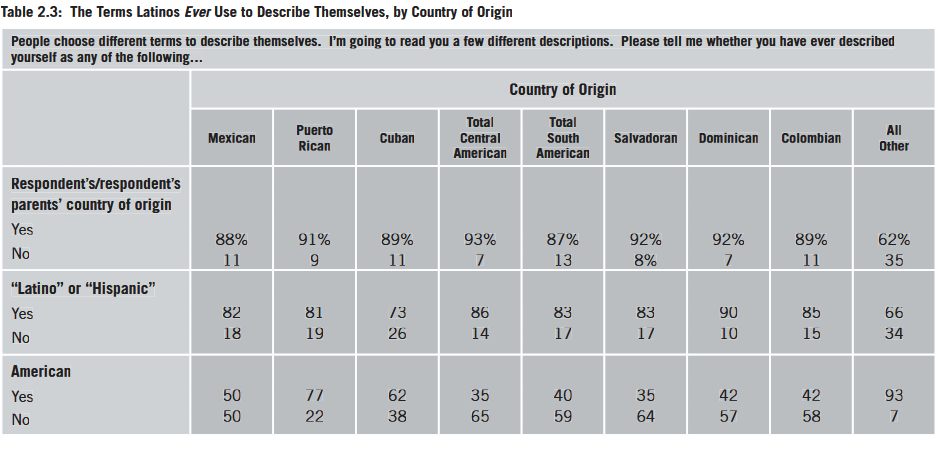
At this time, the Hispanic population was only about 39 million. This same survey found that when asked to pick a “first or only term” to identify themselves, only 21% of Hispanics chose the term “American.” Even among American-born Hispanics, the share of chose “American” was only 46%. Pew would go on to repeat this survey several times.
By 2009, when the Hispanic population reached 49 million, Pew found that 24% of young Hispanics described themselves as “Americans” first while 52% preferred their country of ancestral origin. 20% preferred the terms “Hispanic” or “Latino.” Among second-generation (American born) Hispanics, the share who identified as “American” first rose to 33%. Among third-generation Hispanics, the “America:” first share rose to 50%. This was very modest progress that appeared to hold steady when Pew ran the survey again in 2013. The 2013 data showed 23% of Hispanics most often described themselves as “American,” including 42% of American-born Hispanics. Among second-generation Hispanics, 30% identified as “American.” And among the third-generation, 59% identified most often as “American.”
These incredibly modest levels of integration have since given way to a near total collapse. Between 2009 and 2024 the Hispanic population rose by another 20 million, reaching 68 million. By 2020, the Pew data showed integration had been thrown in reverse. As of 2020, only 14% of Hispanics identified as American. Just 22% of second-generation and 33% of first-generation Hispanics primarily identified as “American.” Furthermore, 44% of Hispanics said they feel “very different” from a typical American. Less detailed data from 2024 shows that identification as “American” remains low among Hispanics, at just 17%.
There was a clear reversal in national identity trends despite efforts to grant citizenship. In 2023, more than 81% of Hispanics were American citizens—a seven-point increase from 2010. It is clear that citizenship is not inspiring American identity.
Hispanics are not unique in this integration failure. Among Asians in the United States, whose population has increased from 980,000 in 1965 to 26 million as of 2024 (and a majority of whom are foreign-born), integration is not substantially better than among the Hispanic population. A 2023 Pew survey found that only 10% identify “American” and 16% identify as “Asian American.”
Only 53% of Asians overall in the United States would consider themselves to be typical Americans.
Furthermore, large shares of these populations feel such a lack of connection to the United States that many want to leave. A March 2024 Monmouth University poll found that 45% of Americans of Color would resettle in another country if “free to do so.” And a February 2025 Harris poll found that 61% of Hispanics and 57% of African Americans have considered leaving the country in the next two years. Among Asians, a 2023 Pew survey found that 26% of Asians, including 30% of those born abroad and 14% born in the United States, would move to their ancestral homeland.
America has never before had such large populations of culturally, ethnically, and religiously disparate foreigners; nor has this country ever attempted to integrate such a large volume of people. These populations are so large that they are able to maintain separate communities and institutions and agitate for their specific ethnic interests (see: Hispanic interest group La Raza, literally translated: “The Race”) rather than adopting the national interests of the United States.
At this time of reflection, the American people have a choice to make, and it is a serious one:
Will America exist in the year 300? Or will we become a balkanized landscape of hyphenated “Americans” with competing foreign interests?
The choice is ours.

03 July 2026