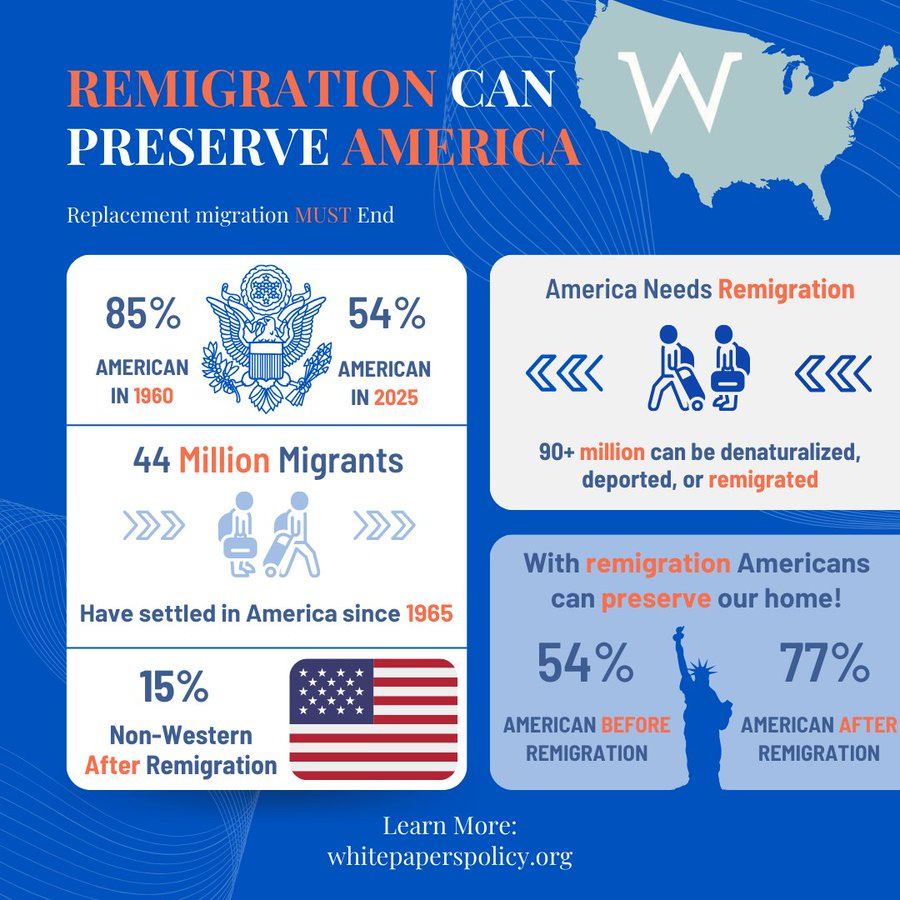
We recently published a series of infographics on X [Follow us at @WhitePapersPol] illuminating the demographic trends in the Western world and highlighting how those trends might be arrested and reversed through sensible remigration programs. These infographics have received a lot of positive feedback and generated questions and discussions from our readers which has been fantastic! One of the most frequent questions we’ve been asked is why some of the projections come in under people’s expectations. For example, our America infographic and indeed our American Repatriation Policy Platform shows that after implementing the sensible remigration policies, the Heritage American share of the United States population would increase 23 points from 54% to 77% share.
Remigration and the Complexity of Communities

-
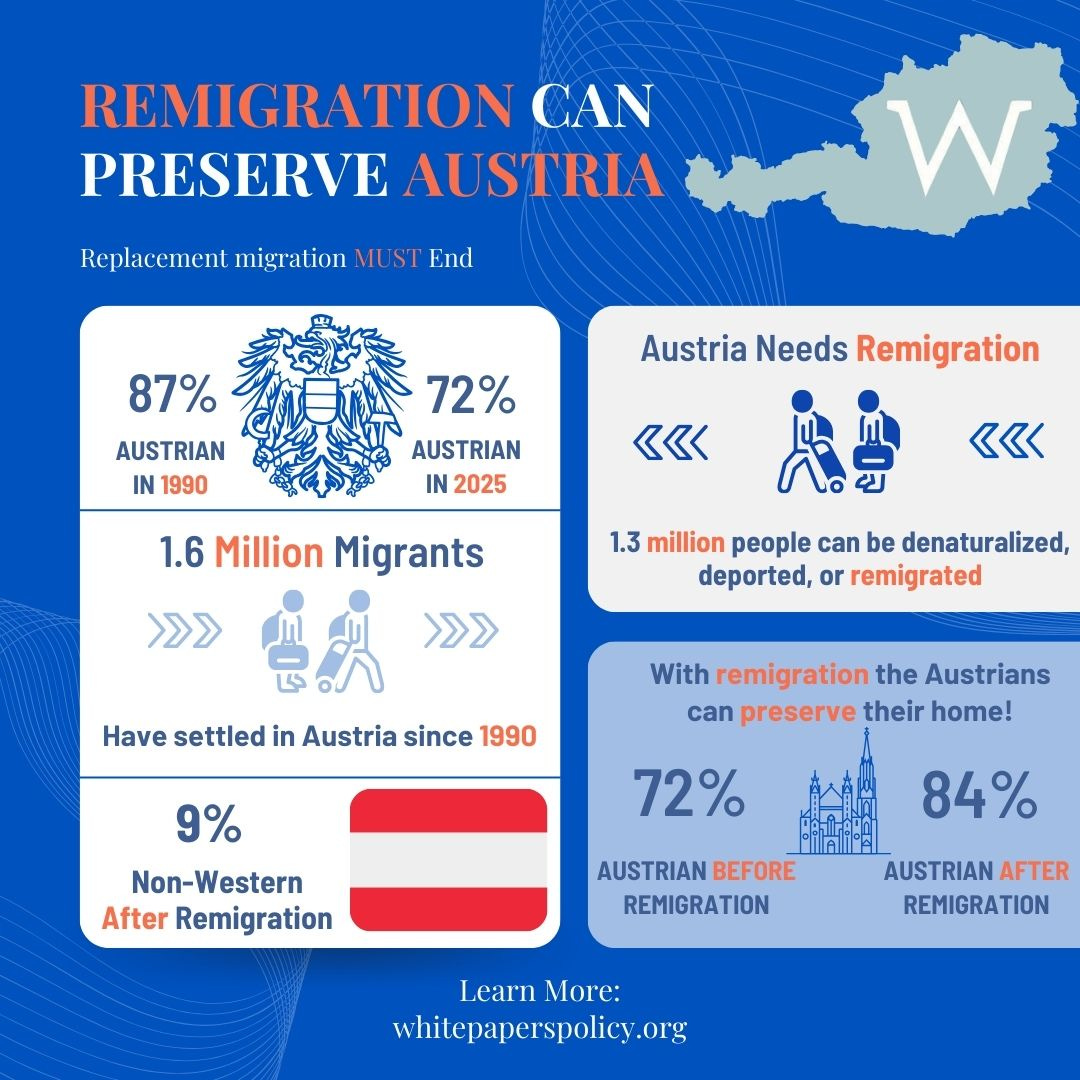
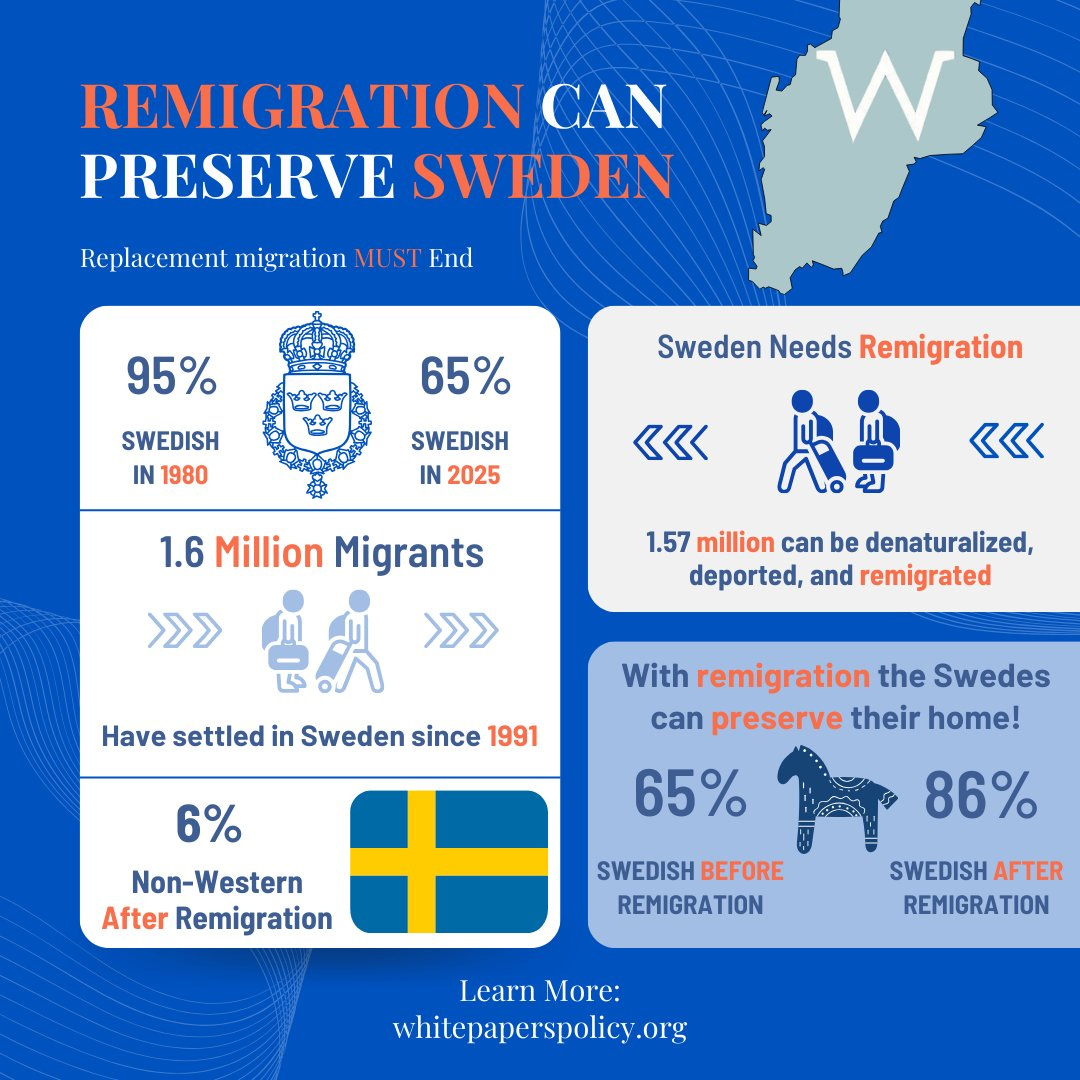
In the Austrian infographic (we have yet to publish a full-length Austrian remigration piece), the native Austrian share of their homeland’s population increased by 15-points from 72% to 87% in a remigration scenario. And in our Swedish infographic, we highlighted that the Swedish share of the population could be increased from 65% today to 86%.
Some people may indeed want to see those numbers significantly higher, but there is a key consideration that White Papers takes into account when crafting our remigration policies: the complexity of human communities.
There is no “standard unit human.” The fundamental basis of nationalism recognizes that people are not economic units that can be exchanged across borders with no consequence. When people have strong community ties with a sense of belonging, there are fewer suicides, fewer mental health problems, and fewer mass murders. Human identity is a set of relationships that extends from the core family. And when a nation has inhabitants that are related more closely to each other, feelings of solidarity and willingness to engage in altruism are higher. Egalitarianism and “race blindness” (which in practice became an excuse to hate White people) have failed on their own merits. There is no “Magic Dirt.” Who lives here and what their connection is to our country matters immensely. The happiest countries are regularly the most ethnically cohesive.
Much as the core of the family is parents and children, the core of Britain is the native British, the core of America is the Heritage American population, and the core of Germany is the German people. Everyone else will be on a spectrum closer or farther from the core. The farther they are from this core population, the better it is that they be remigrated either involuntarily for criminality, fraud, or welfare dependence or voluntarily through monetary, logistical, and cultural incentives.
By keeping these communities in mind, we’ve been able to formulate remigration models that we consider to be fair and just.
Our remigration programs assume that natives with foreign origin spouses and their children will remain within the Western countries in a remigration scenario because our societies are the community to which these families are most strongly connected. In the case of Sweden, about 350,000 native Swedes (10%) are in a relationship with someone of non-Swedish origin; and there are about 836,000 people in the country who are of mixed parentage. Numbers are much the same in most European countries. In the United States about 4-6 million Americans have a spouse who was born abroad, another 3-5 or so million Heritage Americans are married to someone with post-1965 immigrant ancestry and about 15 million American children and young adults have one Heritage American parent and one of post-1965 origin. In fact, our own fantastic Vice President J.D. Vance is married to Usha Vance, a woman with post-1965 origins.
In Britain, we have the example of Mr. Ben Habib who has an English mother and a Pakistani father and who has formed a political party opposed to mass immigration and regularly speaks about how unfortunate it is that the native English are being reduced to a minority in their towns and cities.
-
These individuals are part of families deeply embedded in local and national communities, in wider families, and with strong connections to Western countries. They are, in short, part of our national community in a way that a Somali fraudster, Saudi Islamist, Syrian refugee, or a Venezuelan illegal immigrant can never be.
When we look at the immigrant enclaves such as those in Vienna, Birmingham (UK), New York City, or Malmo that harbor tight-knit and often politically (and even physically) aggressive immigrant communities, we see parallel societies with no connection to our own. These communities exist apart from our own with their own interests and institutions that operate in opposition to ours. It is exactly these groups that are the focus of our remigration policy. They are not part of the complex national community we seek to preserve.
Still, there are people who may not have married into our families but have otherwise established deep ties to Western nations and have assimilated. These are the very few highly-integrated post-1965 immigrants in the United States and Europe who have done their utmost to culturally integrate. In the case of the United States, we estimated that 15-17 million Hispanics would elect to remain in the country in a post-remigration future. This figure is overwhelmingly composed of that small cross section of second and third-generation Hispanic Americans who speak English at home (24 million), practice Protestantism (15 million), and vote in a right-wing/patriotic fashion (21 million). These individuals have—unlike tens of millions of other post-1965 Hispanics—integrated deeply into American families, communities, and culture.
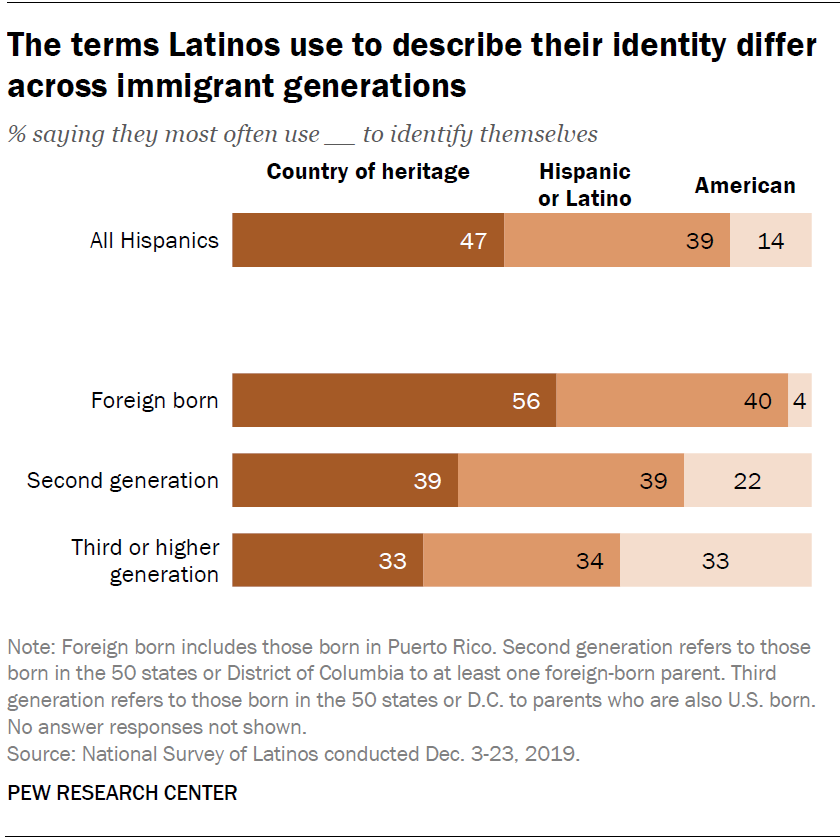
They have no other cultural loyalty, no other patriotic loves, and no other core identity beyond being American. This phenomenon also occurs (with the same rarity) in European countries and is exemplified in individuals like Suella Braverman who are deeply concerned about the demographic replacement of native populations because she and those like her understand that the countries and societies they love are dependent upon the demographic dominance of the native peoples of the West. Many of these individuals came to European countries before the era of mass immigration and had no choice but to integrate into societies that were 85%, 95%, or even 99% native European.
Rather, we are concerned with remigrating the 86% of Hispanics (78% second gen, 67% third gen) who don’t identify as Americans, the majority of Muslims in Britain who believe in Sharia law, and the MANY millions of highly welfare dependent third world immigrants living in ethnic enclaves. These communities treat Western societies as opportunities for welfare benefits, criminal enterprise, sexual conquest (grooming gangs), and religious reprisal (terrorist attacks and riots). They can never be and are incapable of becoming part of our social fabric and prove that large-scale integration is a myth. They are about as far from the core community of the nation as one can be.
Finally, there is the complex issue of historic minorities. These communities often interact heavily with the core nation but are very distinct from it and maintain their own historic institutions, cultures, and interests. In Sweden for example, we do not assume (nor promote) the 36,000 Sami who are native to the Northern regions of Scandinavia would want to leave the country. Similarly we do not think First Nations people would wish to leave Canada or the Maori New Zealand.


24 January 2026