
The Canadian Remigration Policy Platform A Plan for a Demographically Secure Canada
Canada is perfectly within her rights in selecting the persons whom we regard as desirable future citizens. It is not a ‘fundamental human right’ of any alien to enter Canada. It is a privilege… There will, I am sure, be general agreement with the view that the people of Canada do not wish, as a result of mass immigration, to make a fundamental alteration in the character of our population. Large-scale immigration from the Orient would change the fundamental composition of the Canadian population. Any considerable Oriental immigration would, moreover, be certain to give rise to social and economic problems of a character that might lead to serious difficulties in the field of international relations.”
Prime Minister William Lyon Mackenzie King, speech in the House of Commons on post-war Canadian immigration Policy. May 1st, 1947.
Canada’s demographic profile has shifted sharply since Canada’s Liberal, wartime, prime minister William Lyon Mackenzie King declared that it was undesirable to change the fundamental character of Canada’s population.

At the time King spoke these words, Canada had always been and remained a country of European Christians. In 1951, just 4 years after King’s statement before the House of Commons, Canada’s Census showed that Canada was 97% European, 1.2% First Nations, and less than 0.5% Asian. While it is true that Canada had a relatively high immigrant population both before and after the Second World War, immigration was primarily from Britain, other parts of Europe, and to a lesser extent the United States. The foreign-born share of the population sat around 15 percent in the early 1950s and stayed in that range for decades. In 1971, when the Canadian population was still 96.3% of European origin, virtually all immigrants to Canada were British (28.3%), other Europeans (51.4%), or Americans (9.4%). Canada’s immigrant population was 89.1% of Western origin. This is broadly similar to the United States in 1970 when 75% of the immigrant population were other Westerners from Europe, Canada, and the British Isles.
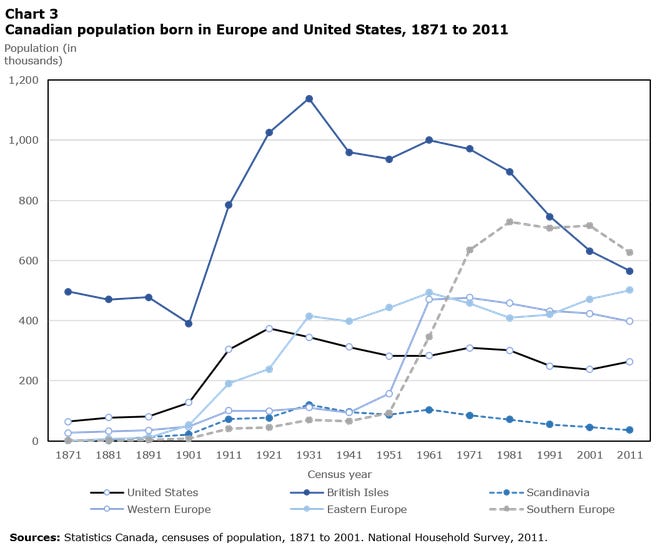
In addition to sensible immigration policies, Canadian fertility was still relatively high in the postwar decades, naturally increasing alongside selective immigration. The population grew from roughly 14 million in 1951 (13.6 million of whom were Westerners) to about 18 million by 1961 and continued expanding through the baby boom. By 1971, Canada’s population was over 21.5 million and more than 20.7 million of those individuals (96.3%) were of Western origin. Immigration policies of both an informal and a formal nature persisted through these decades; and restrictions that favored immigrants from Britain, Northern and Western Europe, and later Southern and Eastern Europe prohibited the demographic change that King warned against in his Commons speech at the end of the war.
The restrictionism and homogeneity of Canada was eventually done away with as policy changes in the 1960s came into force. In 1962, regulations removed most ethnicity and country of origin-based barriers through the Order-in-Council PC 1962-86 and put in place a points-based and skills-based system for admitting immigrants to the country. Construction on this “ethnically neutral” 1967 points-based system continued through the 1960s through the 1960s. Then in 1976, the Immigration Act of 1976 explicitly banned discrimination on grounds of race, national or ethnic origin, color, religion, or sex when applied to any number of areas of life, including immigration. Furthermore, this act marked the formal adoption of multiculturalism under Pierre Trudeau’s government.
As a result of these policies, immigration categories such as family reunification expanded, refugee intakes rose, and the points system proved less restrictive in practice than its designers originally claimed. Immigration volumes climbed. By the late 1980s and 1990s, annual permanent admissions regularly exceeded 200,000. Source regions for immigrants to Canada moved away from the British Isles, Europe, and American (the broader West) and shifted decisively toward Asia, the Caribbean, Africa, and later the Middle East and Latin America (the third world).
The results appear clearly in the census data. Between 1981 and 2021, the European-Canadian share of the population fell from 93.3 percent to 69.8 percent. Visible minorities rose from barely 3% of the population to more than 26 percent by 2021. South Asians, Chinese, Black, Filipino, Arab, and Latin American populations grew rapidly. Immigrants and their Canada-born children drove almost all of the increase. By the 2021 census, nearly one in four people living in Canada was an immigrant (the highest share in more than 150 years). A key driver of this has been the aforementioned change in the origin of the immigrant population. Today more than 83% of immigrants to Canada are non-Western, a share that was less than 11% in the 1950s and 1960s, not to mention all of Canadian history prior to the era of liberalization and multiculturalism.
As a result of multicultural policy making and mass immigration virtually all population growth in Canada is now derived from immigrants and their children. Natural increase declined as fertility fell below replacement (reaching a record low of 1.25 in recent years). By the early 2020s, immigration accounted for well over 90 percent of population growth in most years. Temporary residents (international students, temporary foreign workers, and asylum claimants) surged alongside permanent admissions, pushing the non-permanent resident (NPR) population above 3 million at its peak and accounting for more than 7 percent of the total population.
These decades of multicultural immigration policy have resulted in a Canada that is nearly unrecognizable compared to the historic baseline. Between 1981 and 2021, the share of White Canadians fell from 93.3% of the Canadian population to 69.8%. While from 2021 to 2026, White Papers estimates that the European Canadian population has declined further to roughly 63.7% of the population of Canada. This is a decline of roughly 30-points and has taken place over with the lifetime of nearly all living Canadians.
From 1981, the share of “South Asians” in Canada (those people from India, Bangladesh, Sri Lanka, etc.) has increased from 223,000 individuals to an estimated 3.1 to 3.4 million individuals as of mid-2026. A population increase of 1,290%. The Black population of Canada has rapidly increase from 239,455 in 1981 to 1,574,870 as of 2021, a jump of 557% in just 40 years. In this same period, the number of Filipinos in Canada increased by 1,168% and the Chinese population jumped by 472%.
All the while, the size of the Historic Canadian population has only increased about 13%, from 22.46 million in 1981 to 25.36 million in 2021. Though this is made even less significant by the drastic aforementioned decline in the share of the overall Canadian population.
As of early 2026, the NPR population stood around 2.5–2.7 million, down from a peak above 3.1 million and the total population estimates exceeded 41 million. Immigrants still accounted for roughly 23 percent of the population in the most recent census baseline, with White Papers projections under the reference scenario pointing to an overall immigrant population exceeding 10.3 million and comprising roughly 25% of Canada’s population in late 2026. (17)(18)(19)
These are replacement-level numbers. In total about 33.4% of the Canadian population in 2026 are of non-Western and non-First Nations stock. A share that was less than 2% for all of Canadian history until the 1970s. Canadians ARE being replaced, this is beyond dispute, and it must be reversed if the Canadian nation is to retain its sovereignty.
White Papers Policy Institute material on Canada and parallel Western cases aims to supply a practical framework. The core idea is straightforward: stop further large-scale non-Western immigration, remove those without a lasting legal claim or who have failed to integrate, and offer incentives for voluntary departure by others. The goal is restoration of a stable European-origin majority while respecting the distinct status of Indigenous peoples and those immigrants who have become part of the Canadian national community through marrying a Canadian or having one Canadian and one foreign born parent. (1)(20)
The first step in remigration (not to be confused with immigration restrictionism that will also need to be put in place) is to remove the populations of temporary immigrants. All 2.3 million non-Western temporary residents of Canada should be sent home as their visas expire and their status voids. If they do not leave voluntarily, they will need to be deported. Students completing university programs could perhaps be issued a single extension to complete their education before having to leave the country. Canadians, like all Westerners, are a people who care deeply about fairness.
The second step is revoking permanent resident status from the roughly 2.7 million non-Western immigrants who resident in Canada on such visas. A transition period of 5 years could be put into place so that the roughly 3.8 million non-Western immigrants currently working in the Canadian labor market (both permanent residents and NPR) can be replaced by the more than 2 million European-Canadian and First Nations Canadians who are currently unemployed or underemployed and seeking better employment opportunities.
Mandatory remigration would also cover illegal entrants, visa overstayers, failed asylum claimants, foreign-born criminals (including those with dual citizenship where grounds for revocation exist), and those who obtained status through fraud. In 2019, the Canadian Department of Citizenship and Immigration investigated some 11,000 people for potential immigration fraud and determined that 3,000 of them, or 27%, had committed fraud in obtaining their Canadian citizenship. Investigations in 2011 and 2020 also uncovered widespread fraud, including large-scale cash-for-citizenship schemes being employed by “immigration firms” in the country. These investigations should become widespread and commonplace, seeing that any immigrant who forged their documents in order to get Canadian citizenship has that privilege revoked and is removed to their country of origin.
Our “medium” remigration scenario for Canada.
-EVERY illegal is deported
-Welfare dependent & criminal migrants deported (incl 2nd gen)
-80% cut in visa holders
-A 12-year incentivized remigration program (est ~60% uptake)
Canada would be ~81-82% Canadian/Western, 7% First… pic.twitter.com/0tzouxz5hs
— White Papers Policy Institute (@WhitePapersPol) February 5, 2026
Assuming the 27% fraud rate is broadly applicable, then more than 1.48 million of the 5.5 million naturalized citizens of non-Western origin could face a revocation of their Canadian passport and subsequent deportation.
White Papers can reasonably estimate that more than 6.28 million non-Western immigrants could be deported and or denaturalized and removed from Canada under these mandatory remigration policies. This group represents 45.3% of the non-Western population of Canada and would see the European-Canadian population increase more than 12-points from its current 63.7% population share to 75.1% post-mandatory remigration. Of course, mandatory remigration is not going to reverse the significant demographic change in Canada, and incentivized voluntary remigration will be necessary.