
• About
  • Issues
    • Demographics
    • Economic Policy
    • Foreign Policy
    • Remigration
    • Social Policy
  • Analysis & commentary
Donate

LEVEL2

  • About
  • Issues
    • Demographics
    • Economic Policy
    • Foreign Policy
    • Remigration
    • Social Policy
  • Analysis & commentary
Donate
  • X
  • Telegram
Issues Demographics

The Demographic Timebomb and How to Reverse It

Lucy White covers the ARC 2026 Conference's panel on fertility "The Demographic Time Bomb" yet notices the elephant in the room: Remigration.

The Demographic Timebomb and How to Reverse It
  • At a recent event titled, “The Demographic Timebomb and How to Reverse It,” hosted at the ARC Conference in London, a panel discussed many plausible explanations as to why our birth rate in the West is falling and offered some solutions to help stop the decline. However, they missed two key ingredients: mass immigration as a cause, and remigration as a solution.

    This article presents the ideas put forth by the panel, followed by our analysis to strengthen these arguments. We confront the reality that non-Western mass immigration is having a detrimental impact on young Western people wanting to start families. Remigration solves this.

    Panel discussion: What is causing the demographic crisis in the West?

    Poor timing?

    One of the panelists, Stephen Shaw—CEO of X.Y Worldwide—believes that the West’s demographic crisis is largely due to “unplanned childlessness,” caused by a delay in wanting to start a family and an inability to find the right partner at that time. In his work, Shaw writes that, “Biological fertility doesn’t collapse at 28, but the odds of finding a partner who wants the same future at the same time do.” Shaw also discusses the vitality curve, which shows how the average age of parenthood determines birth rates; when people delay having children until their 30s and 40s, the curve becomes flatter, signifying reduced vitality.

    Katalin Novak, The Former President of Hungary, agrees that unplanned childlessness is one of the biggest problems causing our declining birth rate. Novak explains that the delay in having children is caused, in part, by well-educated women graduating from university and going straight into professional careers, as opposed to the path towards motherhood. Novak advises her audience that it is never too late to start a professional career, but it can be too late to start a family. Novak also draws upon the reality that there are financial disadvantages in raising children, which can be a huge deterrent in starting a family at a young age.

    Gudrun Kugler, a Member of Parliament in Austria, agrees with Shaw and Novak that young people are waiting too long to become parents. Kugler says, “when we get older, we are not aware how quickly our fertility declines.”
  • Less need to have children?

    Catherine Pakaluk, Associate Professor at The Catholic University of America in Washington, DC., draws an analogy between our declining birth rate and the decline of horses used for transportation after the invention of the Model T car (the first mass-affordable car). Pakaluk says, “Children have gone the way of horses. The reason birth rates are really falling is because no one needs a kid — and fewer and fewer people want one.” Pakaluk acknowledges that this is a purely economic argument, while citing two other factors that have also contributed to our birth rate decline: an uptake in birth control, and a more career-driven society.

  • Anti-family messaging, particularly aimed at White people, is pervasive. The media often highlights childlessness as a lifestyle choice.

  • Anti-family messaging?

    The panellist Barbara Socha, Advisor to the President of the Republic of Poland, explains that, “The media often highlights childlessness as a lifestyle choice. Again, everyone is free to choose; but this kind of promotion of a particular lifestyle, especially one without children, is problematic… we now frequently see headlines warning that children will ‘ruin your life’.”

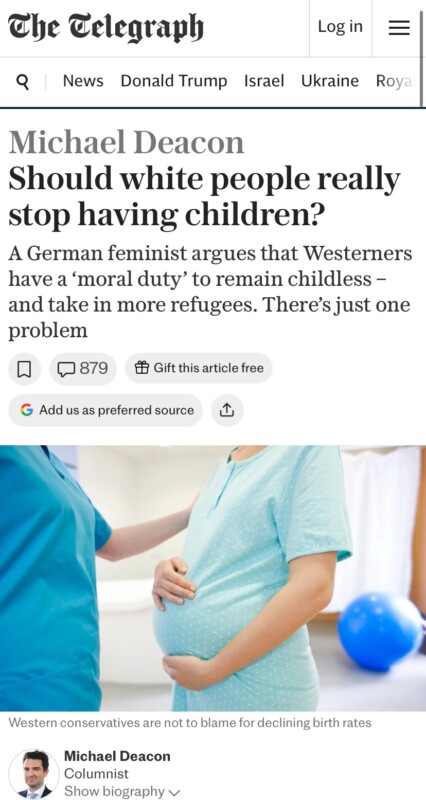
    There is evidence of this in Great Britain. On 30th June 2026, The Telegraph printed a photograph of a White baby on the front cover of the newspaper with the heading, “Should white people really stop having children?” While the author may argue that this was satire, it is highly inappropriate to even entertain this “debate,” yet alone place it on the front cover of the newspaper. Anti-family messaging like this, pushed in Western countries, must stop.

  • Returning to Socha, she says that the issue of the media’s anti-family messaging is compounded by the fact that “The family issue has disappeared from the public debate… no one is talking about families anymore.”

    Socha explains that anti-family messaging “started after the collapse of communism.” This applies to many countries in our region—Hungary, Poland, others—because we began looking so strongly to the West. The West became our aspiration, particularly when it came to careers and what some researchers now call ‘workism.’”

    “Workism” vs Homemakers?

    Socha explains that “Workism, having a job, providing for the family, fulfilling professional aspirations, is, of course, good. The problem arises when it begins to work against something else—specifically, against our private lives.” Socha says that women are under pressure to pursue professional careers, while wanting to become a homemaker has become taboo. The value of work done at home has been overlooked because our systems, namely our pensions and income, do not recognise the contributions of homemakers. Socha praises Hungary’s pro-family policies for providing financial incentives to mothers, which brings financial value to homemaking.

    Panel discussion: How can we reverse the demographic timebomb?

    Pro-family policies?

    Novak draws upon Hungary’s successful family-friendly policies as a solution to the demographic crisis. Put simply, the more children you have, the less tax you pay. Mothers with more than four children have a lifelong exemption from personal income tax. In addition, the government offers a reduction in mortgages and student loans, as well as subsidies for homes, to relieve the financial burden on mothers. According to Novak, Hungary spends twice as much on family policies as the OECD average, relative to its GDP.

    Socha says that the Government of Poland has “prepared a strategy for the next twenty years to change—or to influence the change of—the birth rate. Our main goal is to make Poland the best place for families.” This includes financial support of 800 PLN ($210) per month per child, as well as a willingness to introduce part-time work to the labour market. Socha explains that part-time work was almost non-existent in Poland, which stems from the communist era whereby there was no flexibility in work.

    Security?

    Novak further explains how parents’ desire to protect their family has a net positive outcome for the whole of society, as “anyone who has a child is ready to fight at any time to ensure that their child can live in peace and freedom.” Moreover, “a strong united and healthy family is a guarantee of security.”

  • The women I interviewed felt that God had blessed them through their children.

  • Faith?

    Pakaluk views faith as a core factor as to why some women have larger families. Pakaluk explains, “Children are blessings from God, expressions of God’s goodness, and the purpose of marriage. The women I interviewed felt that God had blessed them through their children.”

    Kugler agrees that faith plays an important role in people’s decision to start a family, stating, “[if you] see yourself as part of a chain in creation, then you look at having children differently. I find it beautiful that the Catholic Church says that having children is passing on the image and likeness of God.”

    Education on the fertility window?

    Shaw says that it is crucial to educate young people in their 20s about the fertility window, so that they do not unintentionally become childless. Many people are unaware how quickly their fertility can drop, and this lack of awareness must urgently be addressed. Shaw also suggests that higher education should be spread over a longer period of time, as opposed to cramming it all in by the age of 22. Shaw says, “The idea that we kind of force people into this high-pressured educational environment, training environment early in life, and then clearly incentivize people to focus on developing their career first, that needs to be rethought through.”

    The Elephant in the Room: Mass Immigration and Demographic Decline

    Mass immigration has eroded the quality of life for the Western population. The country our parents grew up in will not be the same country that our children will grow up in, unless we enact a policy of Remigration.

    The impact of mass immigration on wanting to start a family:

  • Mass immigration has eroded the quality of life for the Western population. The country our parents grew up in will not be the same country that our children will grow up in, unless we enact a policy of Remigration.

  • Dangers—rapes and murders

    As Novak explained, parents want peace, security, and freedom for their children. If they cannot guarantee these outcomes, they are less likely to start families. Mass migration has made our neighbourhoods unrecognizable and considerably less safe.

    In Great Britain, “250,000 young white girls have been subjected to repeated rape, gang rape, trafficking, torture…” by “predominantly Muslim Pakistani gangs.” In addition to the Pakistani rape gangs, the influx of illegal migrants arriving into Europe by small boats is causing a rape epidemic as a whole. The top 5 origin countries of illegal migrants arriving into Great Britain are: Eritrea, Afghanistan, Iran, Sudan and Somalia. These are all Muslim countries, where women are treated as second-class citizens. Almost every day, there is a new story about illegal migrants raping our children. Statistically, we know that Afghans are 22 times more likely to commit sex crimes than Britons. The UK Home Office has dispersed illegal migrants across the country, into towns and villages and often near schools. This creates huge anxiety for young people considering starting a family in Britain.

  • On top of the rape epidemic, our children are being murdered by third world migrants. Recent tragic cases include 18-year-old Henry Nowak, who was murdered by an Indian Sikh in Britain; 17-year-old Louis Hervé, who was murdered by a North African migrant gang in Narbonne, France; 22-year-old Marius Dick, who was murdered by an Afghan in Germany. The list goes on and on and on. It is terrifying. How can parents keep their children safe when their countries are no longer safe?

    Diversity, Equity and Inclusion (DEI) policies discriminate against the Native population

    In Great Britain, Native White British students are already a minority in a quarter of state-funded schools, as well as in all grammar schools, across the country. This is a direct result of the influx of mass immigration, where Natives not only have to compete against foreign students for a place in schools, but are discriminated against whilst “ethnic minority” (ironic given that Whites are, in fact, a global minority) students are pushed ahead by DEI policies. Exacerbating this, Native White British students are taught from a young age in school that they have “white privilege” and are also taught a lie that Black people cannot be racist to White people. These atrocious ideologies make some young people afraid to start a family and send their children to school, where the children would likely become a hated minority in their own country.

    Moreover, DEI policies discriminate against the Native population for job opportunities. Many summer internships programmes, including MI5 and Government departments, only accept applications from ”Black, Asian, Mixed Heritage, or other ethnic minority backgrounds.” Therefore, Native Brits are excluded at the first stage of the job market. When it comes to entering a professional career, most companies have DEI quotas to fill, making it ever more difficult for Native Brits to be hired in their own country. Young people in Western countries who are considering starting a family would detest the thought of their future children being discriminated against in their own country.

    Housing crisis

    In Great Britain, it is estimated that there is a shortage of 6.5 million homes, equating to at least 15 million people. It is no coincidence that the housing shortage coincides almost exactly with mass immigration. There are approximately 14-15 million people of non-Western descent, with no British ancestry, living in Britain, who all need homes.

    Exacerbating this, many foreign nationals live entirely off government benefits in social housing. For example, across England and Wales, 72% of Somalis live in government-funded social housing.

    This is placing huge pressure on Native British families to find and afford to buy a suitable home. First-time buyers are paying 191% more than their parents did in the 1990s. “Over the past four decades, the average earnings-to-house price ratio has more than doubled from 4.0 to 8.1.”

  • It is no coincidence that the housing shortage coincides almost exactly with mass immigration.

  • Solution: Remigration

    A return to normality

    Remigration will allow Western countries to return to normality. Our streets will be safe again from Pakistani rape gangs, illegal migrants, foreign murderers and criminals. Young people will be able to raise families in the same safe countries that they themselves, and their parents, grew up in. This reassurance of safety will encourage the Western birth rate to increase.

    Once migrants are remigrated back to their countries of origin, young people will be reassured that their children will have the freedom to flourish at school and succeed based on merit, without being discriminated against in their own country. Young people will also be confident knowing that their children can progress in successful careers without being stifled by DEI quotas.

    After remigration, young Western families will once again be able to afford to live in homes in their desired neighbourhoods, close to grandparents and relatives. This is because there will more housing available once millions of migrants are repatriated, with the additional benefit of the government no longer subsiding migrants to live in expensive locations such as London.

    Conclusion

    To conclude, it is not possible to discuss why the birth rate is declining in the West and how to reverse the demographic timebomb without confronting the most pressing issue of our time: mass immigration. Thankfully there is a solution: Remigration.

    • Read our British Remigration Policy Platform here.
    • And Our American Repatriation Policy Platform.
    • Support our work by sharing this article and giving to our cause here. Thank you!

    Lucy White proudly serves her country as our UK Policy Fellow focusing on policies for Remigration and Demographic Security in Great Britain. She is a Public Policy Graduate from the University of Cambridge.

  • Related Articles
    • Nationalist Policymaking and Women

      Read
    • Rivers of Blood: Remembering Enoch Powell, Belfast, and Henry Nowak

      Read
    • A “Feminist?” Immigration Policy

      Read

Share this

Written by

Lucy White

UK Policy Fellow

Share this

25 July 2026

Stay informed with our newsletter.

You are now subscribed! An error has occurred!

Help us expand
by donating.

Donate

Follow us on
social media.

  • X
  • Telegram
© WPPI 2026