In the aftermath of the Second World War the British state had, in typical British fashion, diligently set about paying off the United Kingdom’s war debts. Between 1949 and 1991 the British state, underwritten by a population that was on average 98% White British during that time, reduced the debt to GDP ratio of the United Kingdom from 211% in 1949 to 29% by 1991. Then something changed. Something so profound that between 1991 and 2026 the nominal national debt of the United Kingdom rose from £189.17 billion to £2.985 trillion.

An uninformed observer from a previous era would see the national debt of the United Kingdom rise from 29% of GDP to 94% by May of 2026 and assume that the British had entered another prolonged military buildup and subsequently another civilization-defining war. For surely the historic model of Northern European, dare I say Protestant, fiscal prudence would not have impoverished itself so without its very survival at stake?
We of course know the reality is quite the opposite. The British state has impoverished the British nation in order to pay for an increasingly burdensome population of third world immigrants and their descendants who are in various measures both unwilling and unable to integrate and participate in the British economic and social framework.
Many people reading here will already be familiar with these general statistics—that native Britons are a minority in their own capital city and the native English are, at White Papers’ best projections, roughly 71% of the population of England. The economic heart of Britain, London, went from a 90% native British city in 1971 to a 37% native British city as of the 2021 census. These huge populations of non-natives are exceedingly costly and each year the massive budget deficit of the British state goes overwhelmingly to their maintenance in the country.

Before delving into the expenses of the non-British population, it is important to first understand the broadest possible picture. That being which groups are paying the most and taking the most from the Exchequer and how the changing demography of Britain is creating an untenable fiscal situation for the British people and our erstwhile governing class.
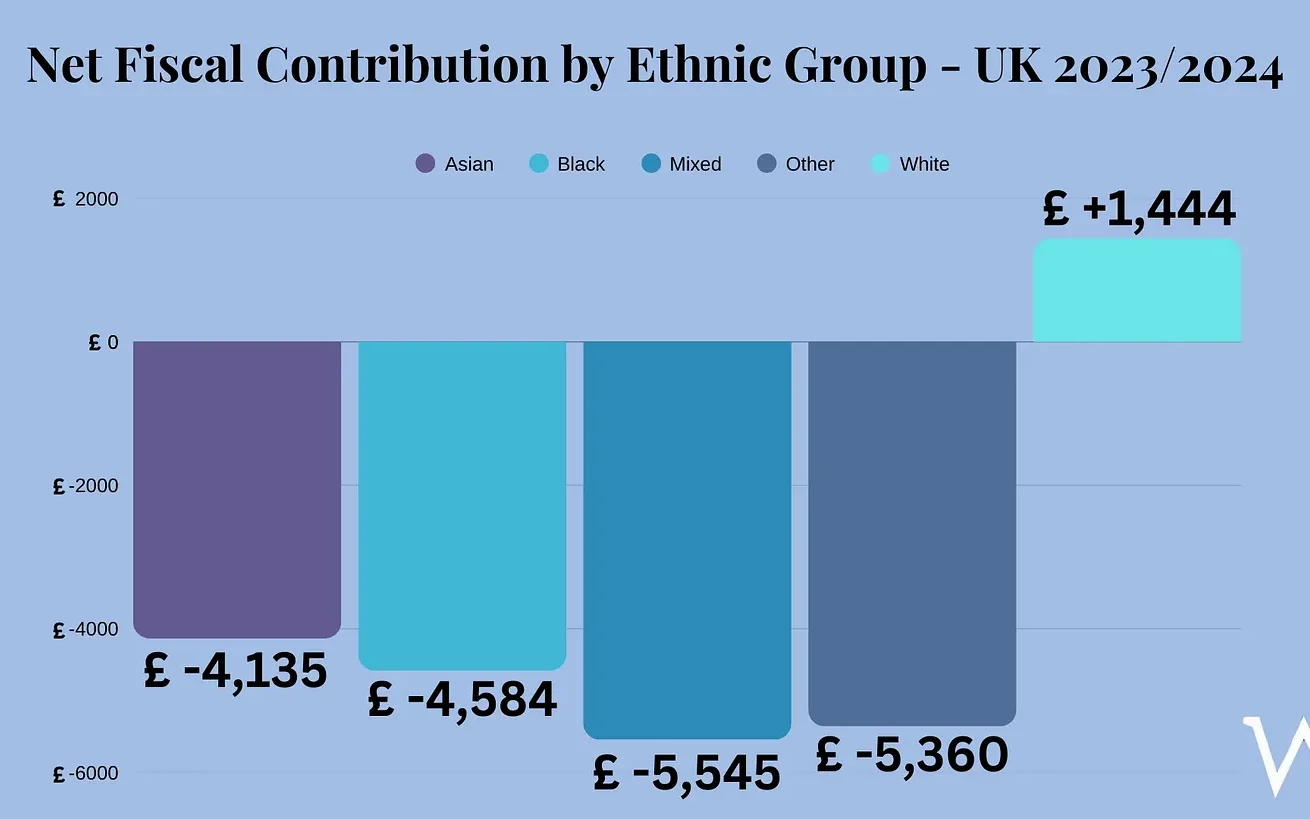
Official UK data released by the Office for National Statistics (ONS) and titled “Effects of taxes and benefits on UK household income” broke down these fiscal burdens by race and ethnicity. The pan-ethnic breakdowns (broad groups: White, Asian, Black, Mixed, Other) appear in Table 23 of the released datasets, available since financial year ending (FYE) 2020. From this data, we know that the only group in the United Kingdom making a net fiscal contribution each year are Whites and, more specifically, White Britons (native Brits). The one group keeping the fiscal ship afloat is also the group being replaced, via mass immigration. The groups which are unable and unwilling to contribute fiscally to the maintenance of the country seem to view it as their right to take as much from the benefits and support systems of Britain as humanly possible.
It is not only affecting these systems, though. It costs more to house, to police, and to medically care for these foreign groups than it does for native Britons.
One great example is in the increasingly ridiculed and ineffective “justice” system in this country. A system that used to be the envy and model of the world. In one great example from the 2024/2-25 year 48% of terrorism related arrests were of non-native Britons (specifically non-Western). A group composing 26.5% of the English population. Non-native Brits account for roughly 23% of all arrests, but this buries the seriousness of the arrests data such as non-British groups being responsible for 32% of arrests involving murder and other homicide-related offenses. Ultimately these arrests and the cost of policing majority non-English areas such as London are adding up quite steeply.
In 1981, England (not the UK as a whole) had a population of some 45 million people, 95.4% of whom were of Western and namely of British extraction. In that same year, the British state spent less than £ 2 billion on policing in the entire United Kingdom. For the 2026 fiscal year, and in an England with a population exceeding 56 million, the policing budget for England (and Wales) will exceed some £21 billion, an increase of more than 75% from the £12.1 billion policing budget of 2016.

For comparison, and to dismiss any claims about inflationary and or geographic pressures, we can look to the example of Poland. Poland is 28% larger than Britain, has land borders on all sides except to the North and sports a population of about 38 million people (95% of whom are native Poles) which is nearly the same as the 41-42 million native Brits who reside in England. Despite having a larger land area and land borders on all sides by the North Sea, the Polish spend substantially less policing their country. The budget adopted by the Polish government for policing in 2026 is a mere £3.88 billion.
Many will try to assign this difference to force size and compensation, but that is nowhere near the whole story. If we were to scale the Polish police force up from its current size of 102,500 personnel to the English and Welsh total of 145,900 personnel and increase the median wage of Polish officers from £23,000 to the median wage of British officers at £47,000, the hypothetical Polish policing budget would still be £9.5 billion or 75.41% smaller than England and Wales’s actual 2026 policing budget. It is unavoidable that the difference is clearly one of demographics. It is cheaper to police a homogeneous Western society than it is to police an increasingly diversified one. In short, we can attribute most of the difference in police spending to the diversified nature of England. A cost of roughly £12 billion each year.
Public sector spending on criminal justice does not stop with arrests or even trials, but with the care of prisoners in the overburdened British prison system. This is yet another area where ethnic diversity and the UK’s burgeoning population of recent and multigenerational foreigners cause the native British people to continue to sacrifice their safety, money, and resources for people who do not belong in Britain.
There are, by the latest count, 87,499 people in His Majesty’s custody. Many of these prisoners are not native Britons and are of first- and second-generation immigrant origin. According to government data from January through March of 2026 some 10,123 foreign national offenders comprise 12% of the UK prison population. Further data reveals that 27% of the prison population is of non-Western origin, and from these two datapoints, White Papers estimates that some 35% to 40% of the British prison population are not of native British extraction.
The fiscal cost of a prisoner in Britain is enormous. In a publication from the 26th of March, 2026 the Ministry of Justice / HM Prison & Probation Service (HMPPS) stated that annual per prison place is now £59,026 per year. Using these figures, we can reasonably estimate that the British state is spending more than £2.06 billion each year housing non-British criminals in the United Kingdom and at the expense of native British taxpayers.
If foreign and non-British criminals within Britain were not a serious enough concern, most people are now well versed in how the British state has busied itself importing tens of thousands of non-Western asylum seekers and is sparing no expense to gather up, house, feed, and maintain this population.
The British asylum system currently costs the taxpayer roughly £4 billion a year, but costs are increasingly rapidly. Data released in 2026 revealed to the British public that approximately £4.2 billion had been spent on asylum seeker support, resettlement, and accommodation in the previous fiscal year, only slightly lower than the peak of £4.7 billion in 2023/2024. If the British state had redirected these 2026 funds to deportations rather than housing asylum seekers, it could have facilitated the enforced deportations of roughly 86,000 people; but instead it spent these funds housing foreign men in British towns and villages near our schools and homes.
Housing and caring for asylum seekers is nowhere near the largest fiscal burden of the non-British population, though. One of the largest areas of expenditure is on health through the NHS. Non-Britons are simultaneously burdening the NHS with their health problems and causing its budgetary demands to expand beyond anything the native British are capable of sustaining through their tax contributions.
In England, the funding for the English National Health System (NHS) comes from the Department of Health and Social Care, which has a 2025/2026 budget of about £217 billion, roughly £203.4 billion of which goes to daily NHS operations such as paying for staffing and material. On a per capita basis, the NHS in England has been spending roughly £3,800 per person from 2026 onward. This does not paint a full picture, though. Certain groups utilize services at much higher rates than native Britons.
White Papers has previously covered the fact that foreigners in the United Kingdom are much more likely to utilize ambulance and A&E services, substantially driving up healthcare expenditure in the UK. We have also written about how spending on diseases unique to minority populations is massively driving up NHS costs with one example being a February 2022 announcement by the NHS wherein it was announced they would be paying for “the most expensive drug in the world.” The drug in question is to treat a genetic disorder known as metachromatic leukodystrophy, this disease leads to nervous system and organ damage and has been linked to inbred populations. This has become a necessity due to the increasing size of the Pakistani, Indian, and other South Asian populations, which have a high propensity for inbreeding.
Other data published on admission rates shows that Asians in the United Kingdom are 1.40 times more likely to be hospitalized than White Britons while Black persons in the UK are 1.37 times more likely to be admitted to the hospital. A May 2026 NPEU and Oxford study found that it costs the NHS £844 more to care for a Black woman and £737 more to care for an Asian woman in maternity care than to care for a White British woman. I am not even getting into the data on specific diseases such as TB or the exorbitant cost of caring for the mental health of the minority population who are reliant on certain diagnoses for their benefits.
If I were to create a simple pro-rata share of NHS costs, assuming all other spending trajectories remained the same regardless of ethnicity, the NHS in England is spending some £41 billion a year on the non-Western/non-British population. If I were to factor in the aforementioned hospitalization rates and maternity costs, then we are looking at an annual budgetary burden of 22% of the English NHS spending or about £48 billion each year. I cannot emphasize enough that this is a simple calculation using only a few data sets and therefore likely vastly understating the fiscal burden of the non-British population on the English NHS.
To cite but one example, there is significant NHS spending on the lawsuits resulting from clinical negligence by medical staff. A 2021 report highlighted that clinical negligence administration, claims, payouts, and other related activities are costing the NHS some £8 billion annually. A 2023 NHS report went on to add some detail to these claims, revealing that ethnic minority NHS practitioners are more than 1.3 times as likely to be hit with a clinical negligence claim. Similarly, foreign-born practitioners in the United Kingdom are 1.8 times more likely to be found to be negligent in their duties. In short, English taxpayers are subject to both massive negligence by foreign-born medical staff and to the increased taxes necessary to pay for this negligence.
Then there are the schools where English and British children are, according to the 2025/2026 pupil data, only 59.7% of the school pupil population. In 2025/2026 the budget for schools in England reached £65.3 billion, up from roughly £57.3 billion in 2023. The 2025/2026 data shows that funding has now reached some £8,390 per pupil per year. These numbers are by far the highest on record and are expected to continue to increase as the costs of maintaining schools are expected to increase by some 7% in the next fiscal year.
Still, with a school-age population of roughly ~8.36 million in 2024/2025, the British state is spending an incredible amount of money educating non-Western non-British children. If I apply a pro-rata approach to this data, it is clear that the British government is spending some £27.1 billion of the English education budget on attempting to educate non-Western and non-British students. The native British are paying substantially in order to educate children who are not their own and with whom their children must compete for places in university and later the employment market.
I have thus far outlined how the British are paying to police, care for, educate, and import foreigners and maintain their children. But what of housing them? Britain faces an acute housing crisis after all, and yet it is the British taxpayer paying billions to give homes and entire neighborhoods and cities over to strangers.
In the 2025/2026 budgetary year, Westminster poured roughly £37–39 billion into the social housing system, and this is not incorporating the more than £39 billion in capital expenditure the government is planning to spend over the next 10 years. Regardless, a huge portion of this spending is going towards housing the non-British on our own soil. The most recent data from the English Housing Survey (2024/2025) shows that 22% of social renter holds are headed by a person with a non-British background and that 13% of social housing household heads are foreign nationals.
If I once again forego deeper detail and simply focus on the pro-rata rates of spending, then the British state is spending at least £8.5 billion on housing non-Britons in homes which British families could be occupying instead.
I have, without touching mammoth areas of public spending like universal credit (direct welfare transfers), outlined more than £101.86 billion in spending by the British state on the non-British population for the 2025/2026 fiscal year. Strikingly but perhaps not of no shock, this figure represents some 77.16% of the £132 billion deficit for the 2025/2026 fiscal year. It is very likely that if it were not for this spending on non-Britons, the required infrastructure spending due to population growth, and spending on programs such as Universal Credit (which reached £92 billion in 2025/2026) the British state would be in a much better, if not outright healthy, fiscal position. In fact, it appears that there would be a modest budget surplus and the ability to both pay down our national debt and give the British people a desperately needed tax cut.
Britain is a wealthy country with a productive British population, but a growing non-Western demographic cohort is impoverishing the nation. It is time to reverse this trend.

Related articles: