H. R. 1924
To reform the immigration system of the United States by establishing regional quotas for immigrant visas modeled on historical principles, capping total immigration, limiting family-based immigration to spouses and minor children, and for other purposes.
IN THE HOUSE OF REPRESENTATIVES
January __, 2026
A BILL
To reform the immigration system of the United States by establishing regional quotas for immigrant visas modeled on historical principles, capping total immigration, limiting family-based immigration to spouses and minor children, and for other purposes.
Be it enacted by the Senate and House of Representatives of the United States of America in Congress assembled,
SECTION 1. SHORT TITLE.
This Act may be cited as the “Immigration Quota Act of 2026”.
SEC. 2. WORLDWIDE NUMERICAL LIMITATION ON IMMIGRANT VISAS; ELIMINATION OF UNLIMITED IMMEDIATE RELATIVES CATEGORY.
Section 201 of the Immigration and Nationality Act (8 U.S.C. 1151) is amended—
(1) by striking subsection (b);
(2) by amending subsection (a) to read as follows:
“(a) Worldwide Level.—The worldwide level of immigrant visas shall not exceed 200,000 in any fiscal year.”; and
(3) by striking subsections (c), (d), and (e) and inserting the following:
“(c) Allocation of Visas.—
“(1) Family-sponsored immigrants.—Not more than 100,000 of the visas made available under subsection (a) may be issued to family-sponsored immigrants described in section 203(a).
“(2) Employment-based immigrants.—Not more than 100,000 of the visas made available under subsection (a) may be issued to employment-based immigrants described in sections 203(b) and 204.”.
SEC. 3. LIMITATION OF FAMILY-BASED IMMIGRATION TO SPOUSES AND MINOR CHILDREN.
Section 203(a) of the Immigration and Nationality Act (8 U.S.C. 1153(a)) is amended to read as follows:
“(a) Family-Sponsored Immigrants.—Visas shall be allocated to family-sponsored immigrants (subject to the numerical limitations in section 201(c)(1)) in the following order of preference:
“(1) Spouses and unmarried children under 21 years of age of citizens of the United States.
“(2) Spouses and unmarried children under 21 years of age of lawful permanent residents.”.
SEC. 4. ELIMINATION OF DIVERSITY VISA PROGRAM.
Section 203 of the Immigration and Nationality Act (8 U.S.C. 1153) is amended by striking subsection (c).
SEC. 5. ESTABLISHMENT OF REGIONAL QUOTAS; REPLACEMENT OF PER-COUNTRY LIMITS.
Section 202 of the Immigration and Nationality Act (8 U.S.C. 1152) is amended—
(1) in subsection (a), by striking paragraph (2) and redesignating paragraphs (3) and (4) as paragraphs (2) and (3), respectively; and
(2) by adding at the end the following new subsection:
“(f) Regional Limitations.—
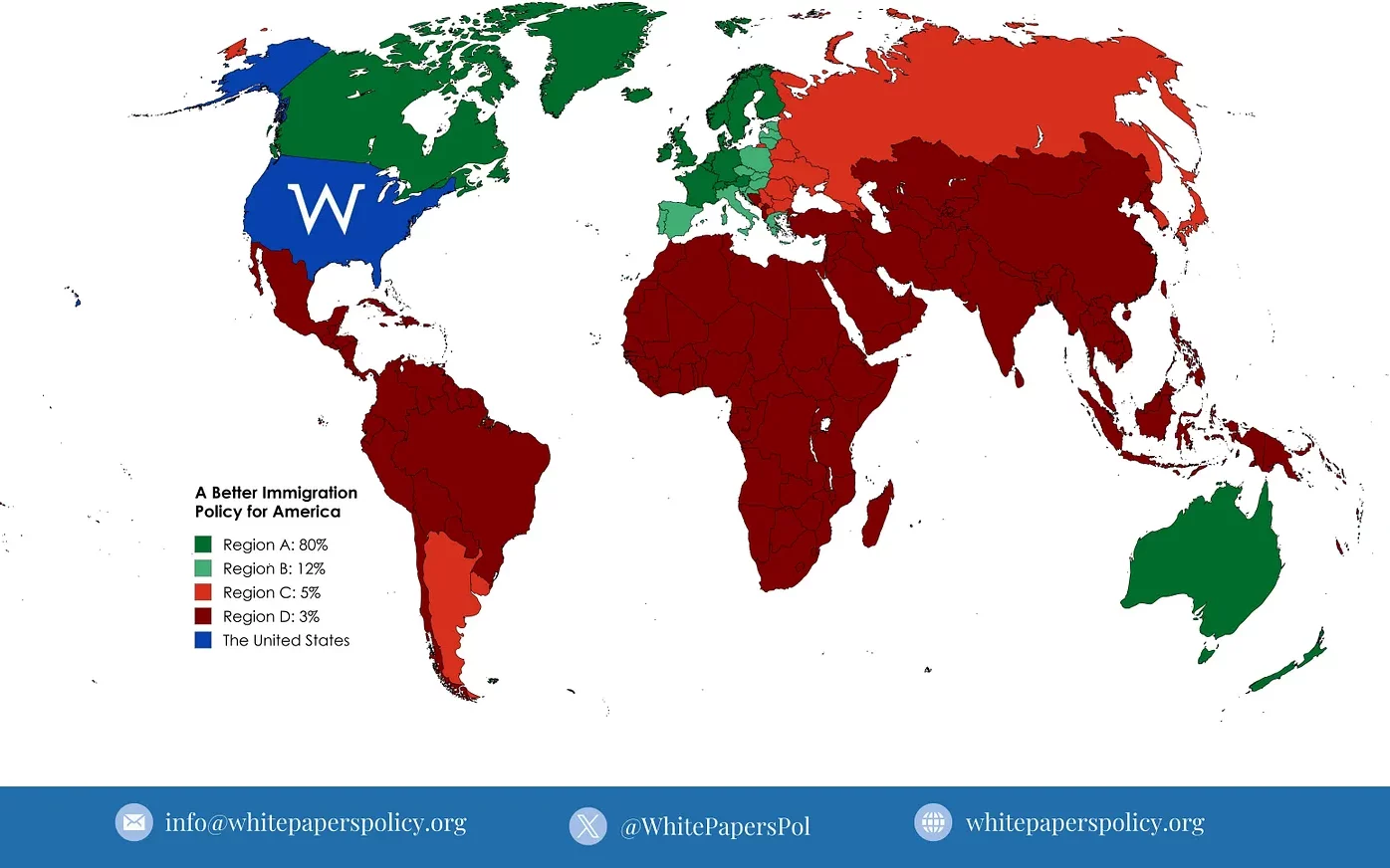
“(1) In general.—Notwithstanding any other provision of this section, the total number of immigrant visas issued in any fiscal year to natives born in countries assigned to each region under paragraph (2) may not exceed the following percentages of the worldwide level specified in section 201(a):
“(A) Region A: 80 percent.
“(B) Region B: 12 percent.
“(C) Region C: 5 percent.
“(D) Region D: 3 percent.
“(2) Definition of regions.—For purposes of this subsection, countries are assigned to regions as follows:
“(A) Region A.—Australia, Austria, Belgium, Canada, Denmark, Finland, France, Germany, Iceland, Ireland, Lichtenstein, Luxembourg, Monaco, Netherlands, New Zealand, Norway, Sweden, Switzerland, United Kingdom.
“(B) Region B.—Croatia, Czech Republic, Cyprus, Estonia, Greece, Hungary, Italy, Latvia, Lithuania, Malta, Poland, Portugal, Slovakia, Slovenia, Spain.
“(C) Region C.—Argentina, Armenia, Belarus, Bulgaria, Georgia (Republic of), Japan, Macedonia, Moldova, Montenegro, Romania, Russia, San Marino, Serbia, South Korea, Ukraine, Uruguay.
“(D) Region D.—All countries not assigned to Region A, Region B, or Region C.”.
SEC. 6. ABOLITION OF THE H-1B NONIMMIGRANT VISA PROGRAM, CERTAIN OTHER NONIMMIGRANT VISA CATEGORIES, AND THE OPTIONAL PRACTICAL TRAINING PROGRAM.
(a) Abolition of H-1B Visas.—Section 214(g)(1)(A) of the Immigration and Nationality Act (8 U.S.C. 1184(g)(1)(A)) is amended by striking “65,000” and inserting “0”.
(b) Abolition of International Cultural Exchange (Q), Informant (S), Trafficking Victim (T), and Crime Victim (U) Visas.—Section 101(a)(15) of the Immigration and Nationality Act (8 U.S.C. 1101(a)(15)) is amended by striking subparagraphs (Q), (S), (T), and (U).
(c) Termination of Optional Practical Training Program.—
(1) In general.—Notwithstanding any other provision of law or regulation, no alien admitted as a nonimmigrant under subparagraph (F) or (M) of section 101(a)(15) shall be authorized to engage in employment in the United States following the completion of the alien’s course of study, except for employment that is directly required as part of the academic curriculum or on-campus employment authorized under regulations in effect on the date of enactment of this Act.
(2) Revocation of inconsistent regulations.—Any regulation authorizing optional practical training (including pre-completion or post-completion optional practical training or extensions of status for such training) for aliens described in paragraph (1) is hereby revoked.
SEC. 7. STRENGTHENING AND CLARIFICATION OF PUBLIC CHARGE INADMISSIBILITY AND PROHIBITION ON USE OF WELFARE BENEFITS BY IMMIGRANTS.
(a) Public Charge Inadmissibility.—Section 212(a)(4) of the Immigration and Nationality Act (8 U.S.C. 1182(a)(4)) is amended to read as follows:
“(4) PUBLIC CHARGE.—
“(A) IN GENERAL.—Any alien who, in the opinion of the consular officer at the time of application for a visa or the Attorney General or Secretary of Homeland Security at the time of application for admission or adjustment of status, is likely at any time to become a public charge is inadmissible.
“(B) EXCEPTION FOR SPOUSES AND MINOR CHILDREN OF UNITED STATES CITIZENS.—Subparagraph (A) shall not apply to an alien who is the spouse or an unmarried son or daughter under 21 years of age of a citizen of the United States.
“(C) MINIMUM FACTORS FOR DETERMINATION.—In determining whether an alien is likely to become a public charge under subparagraph (A), the consular officer, the Attorney General, or the Secretary of Homeland Security shall, at a minimum, consider the alien’s age, health, family status, assets, resources, financial status, education, skills, employment history, and any prior receipt of public benefits.
“(D) DEFINITION OF PUBLIC BENEFITS.—For purposes of this paragraph, the term ‘public benefits’ includes any Federal, State, or local means-tested cash assistance, medical assistance (except emergency medical services), food assistance, housing assistance, or other benefit designated as means-tested by the Secretary of Homeland Security.”.
(b) Deportability for Receipt of Public Benefits.—Section 237(a)(5) of the Immigration and Nationality Act (8 U.S.C. 1227(a)(5)) is amended to read as follows:
“(5) PUBLIC CHARGE.—Any alien who, at any time after admission as an immigrant, receives one or more public benefits (as defined in section 212(a)(4)(D)) is deportable.”.
SEC. 8. ESTABLISHMENT OF STATUTORY CAP ON REFUGEE ADMISSIONS WITH LIMITED PROVISION FOR CONGRESSIONAL APPROVAL OF TEMPORARY INCREASES.
Section 207 of the Immigration and Nationality Act (8 U.S.C. 1157) is amended—
(1) in subsection (a)—
(A) by striking paragraphs (1) through (5) and inserting the following:
“(1) Except as provided in paragraph (2), the number of refugees who may be admitted under this section in any fiscal year shall not exceed 10,000.
“(2) The President may determine that a higher number of refugees, not to exceed 50,000 in any fiscal year, is justified by humanitarian concerns or is otherwise in the national interest. Any such determination shall have no force or effect unless Congress enacts a joint resolution approving the higher number within 90 days after the President transmits to Congress a notification containing—
“(A) the proposed higher number;
“(B) the reasons for the proposed higher number; and
“(C) the fiscal year to which the higher number would apply.
If no such joint resolution is enacted within the 90-day period, the number of refugees who may be admitted in that fiscal year shall be 10,000.”; and
(2) by redesignating subsection (b) as subsection (c) and inserting after subsection (a) the following new subsection:
“(b) Refugee admissions under this section shall be separate from and shall not count against the worldwide level of immigrant visas established under section 201(a).”.
SEC. 9. INCREASE IN REQUIRED PERIOD OF RESIDENCE FOR NATURALIZATION.
(a) General Requirement.—Section 316(a)(1) of the Immigration and Nationality Act (8 U.S.C. 1427(a)(1)) is amended by striking “five years” and inserting “10 years”.
(b) Preservation of Existing Shorter Periods for Spouses and Minor Children of United States Citizens.—
(1) The amendment made by subsection (a) shall not apply to spouses of United States citizens, who shall remain subject to the residency requirements of section 319(a) of such Act (requiring 3 years of continuous residence after admission for permanent residence while living in marital union with the citizen spouse).
(2) Minor unmarried children under 21 years of age of United States citizens shall remain eligible for naturalization under the general requirements in effect prior to the amendment made by subsection (a) (requiring 5 years) or through derivative or automatic acquisition provisions as applicable under sections 320 and 322 of such Act.
SEC. 10. CLARIFICATION THAT BIRTH IN THE UNITED STATES DOES NOT CONFER CITIZENSHIP ABSENT A UNITED STATES CITIZEN PARENT.
Section 301 of the Immigration and Nationality Act (8 U.S.C. 1401) is amended—
(1) in the matter preceding subsection (a), by inserting “, subject to subsection (i),” after “The following shall be nationals and citizens of the United States at birth”; and
(2) by adding at the end the following:
“(i) Notwithstanding any other provision of this section, a person born in the United States on or after the date of the enactment of the Immigration Quota Act of 2026 shall be a national and citizen of the United States at birth only if at least one parent of the person is a citizen of the United States at the time of the person’s birth.”
SEC. 11. PROHIBITION ON SANCTUARY JURISDICTIONS AND WITHHOLDING OF CERTAIN FEDERAL FUNDS.
(a) In General.—No Federal funds (including grants, contracts, or other financial assistance) administered by the Department of Justice, the Department of Homeland Security, or any other Federal agency may be provided to any State or political subdivision of a State that—
(1) has in effect any law, policy, or procedure that prohibits or restricts any government entity or official from complying with a detainer issued by the Secretary of Homeland Security under section 287(d) of the Immigration and Nationality Act (8 U.S.C. 1357(d)) or otherwise cooperating with Federal immigration enforcement authorities in the identification, apprehension, detention, or removal of aliens not lawfully present in the United States; or
(2) prohibits or restricts any government entity or official from sending to, or receiving from, the Department of Homeland Security information regarding the citizenship or immigration status (lawful or unlawful) of any individual, in violation of section 1373 of title 8, United States Code.
(b) Enforcement.—The Attorney General and the Secretary of Homeland Security shall—
(1) determine, on an annual basis, which States and political subdivisions are not in compliance with subsection (a); and
(2) withhold all funds described in subsection (a) from any State or political subdivision determined to be non-compliant until the Attorney General and the Secretary certify that the jurisdiction is in full compliance.
SEC. 12. STATE AUTHORITY OVER CERTAIN IMMIGRATION ENFORCEMENT ACTIONS.
(a) Authority of Governors To Petition for Revocation of Status and Initiation of Removal Proceedings.—Title II of the Immigration and Nationality Act (8 U.S.C. 1151 et seq.) is amended by inserting after section 216A the following new section:
“SEC. 216B. STATE AUTHORITY TO PETITION FOR REVOCATION OF STATUS AND REMOVAL OF CERTAIN ALIENS.
“(a) Petition for Revocation of Status.—
“(1) In general.—The governor of any State may submit to the Secretary of Homeland Security a petition to revoke the nonimmigrant or immigrant status of any alien present in that State if the governor certifies that the alien—
“(A) has been convicted of any felony or two or more misdemeanors under State or Federal law; or
“(B) has received any public benefit (as defined in section 212(a)(4)(D)) after admission as an immigrant or nonimmigrant.
“(2) Action by Secretary.—Upon receipt of a petition under paragraph (1), the Secretary shall—
“(A) revoke the alien’s status; and
“(B) place the alien in removal proceedings under section 240.
“(b) Initiation of Removal Proceedings.—
“(1) In general.—The governor of any State may notify the Secretary of Homeland Security of any alien present in that State who the governor believes is removable under any ground specified in section 237 or inadmissible under section 212(a).
“(2) Action by Secretary.—Upon receipt of such notification, the Secretary shall initiate removal proceedings against the alien under section 240.
“(c) State Opt-Out From Immigrant Settlement.—
“(1) In general.—The governor of any State may, by executive order or proclamation, declare that the State opts out of the settlement or resettlement of new immigrants (including refugees admitted under section 207, asylees granted asylum under section 208, and aliens admitted or adjusted under sections 201–203) within the State for a period of 5 years.
“(2) Renewal.—A declaration under paragraph (1) may be renewed by the governor for additional 5-year periods.
“(3) Effect.—During any period in which a State has an effective opt-out declaration under this subsection—
“(A) the Secretary of Homeland Security shall not approve any change of address to that State for an alien newly admitted as an immigrant or nonimmigrant;
“(B) no refugee or asylee shall be placed or resettled in that State under any Federal or voluntary agency program; and
“(C) any alien who moves to that State in violation of this paragraph shall be deemed to have violated the terms of their admission and shall be placed in removal proceedings.
“(4) Limited opt-out.—A governor may issue a declaration under paragraph (1) that applies only to specified categories of immigrants (such as refugees, asylees, or immigrants from particular regions as defined in section 202(f)) rather than all immigrants.”.
(b) Conforming Amendment.—The table of contents of the Immigration and Nationality Act is amended by inserting after the item relating to section 216A the following:
“Sec. 216B. State authority to petition for revocation of status and removal of certain aliens.”.
SEC. 13. STATE AUTHORITY TO PETITION FOR DENATURALIZATION OF NATURALIZED CITIZENS IN VIOLATION OF LAW.
(a) Additional Grounds for Revocation of Naturalization.—Section 340 of the Immigration and Nationality Act (8 U.S.C. 1451) is amended by adding at the end the following new subsection:
“(h) Post-Naturalization Violations of Law.—In addition to any other grounds provided under this section or any other provision of law, a district court shall revoke and set aside the order admitting a person to citizenship and cancel the certificate of naturalization if the court finds, in a proceeding brought under this section, that the person, after the date of naturalization—
“(1) was convicted of any criminal offense (including any felony or misdemeanor);
“(2) was found to have violated any civil law or regulation (including any civil judgment, administrative finding, or civil penalty); or
“(3) violated any immigration law or regulation.”.
(b) State Petition Authority.—Section 216B of the Immigration and Nationality Act (as inserted by section 13 of this Act) is amended by adding at the end the following:
“(d) Petition for Denaturalization.—
“(1) In general.—The governor of any State may submit to the Attorney General a petition requesting the institution of proceedings under section 340 for the revocation of naturalization of any naturalized citizen present in that State if the governor certifies, with supporting evidence, that the citizen has, after the date of naturalization—
“(A) been convicted of any criminal offense;
“(B) been found to have violated any civil law or regulation; or
“(C) violated any immigration law or regulation.
“(2) Action by Attorney General.—Upon receipt of a petition under paragraph (1), the Attorney General shall direct the appropriate United States attorney to institute a civil action in the appropriate United States district court for the revocation of the naturalized citizen’s naturalization on the grounds specified in section 340(h).”.
SEC. 14. EFFECTIVE DATE.
This Act and the amendments made by this Act shall take effect on the date of the enactment of this Act.
How to Support White Papers:
We keep our policy analysis free because we’re dedicated to the independence and prosperity of our people. But we rely on our paid subscribers to grow and thrive!
White Papers is a reader-supported publication. To receive new posts and support my work, consider becoming a free or paid subscriber.