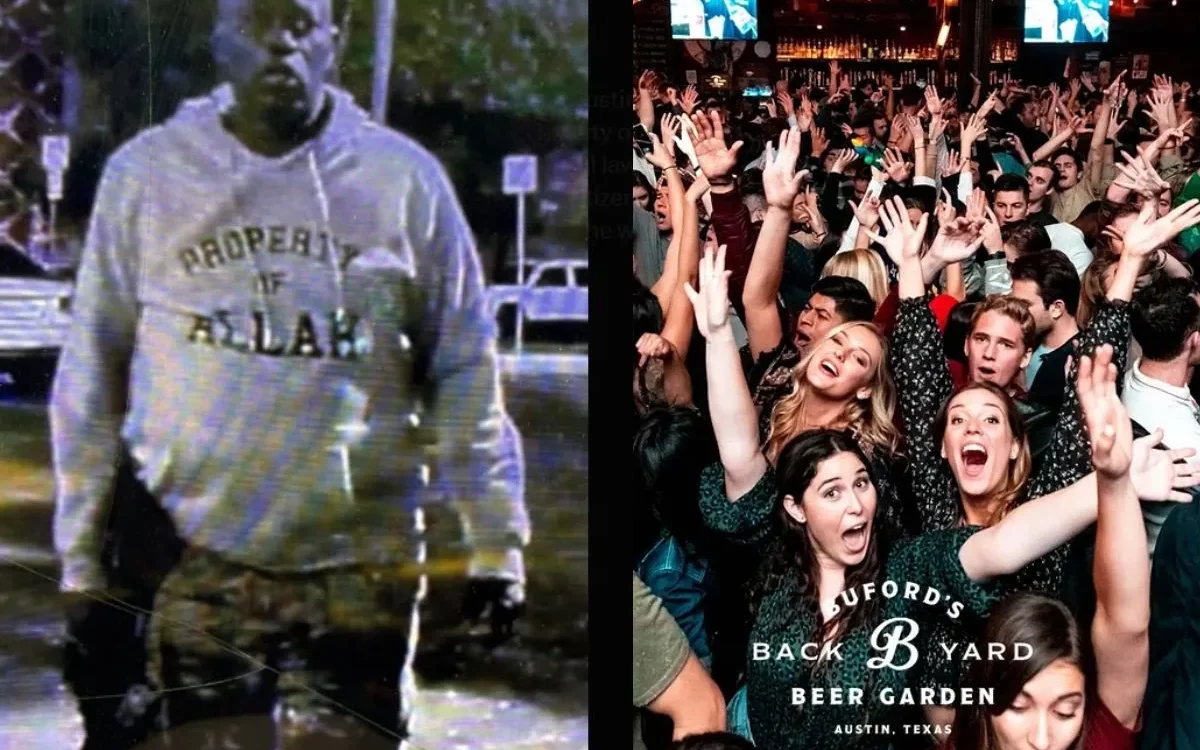
After the latest bombing of Iran, there were worries that Iranians might commit terror in the US. There actually was an attack, which can fairly be considered a terrorist attack, in Austin, TX, but it wasn’t an Iranian, it was a black African immigrant from Senegal, 53-year-old Ndiaga Diagne, who has American citizenship.
Diagne fired a great many shots, wounding 14 people and killing three. Police responded within 56 seconds of the attack.
Senegal is a 97% Muslim country, and the attacker was wearing clothing featuring an Iranian flag and the words “Property of Allah.”

The FBI is “investigating” whether it was terrorism…
FBI Acting Special Agent in Charge Alex Doran confirmed that indicators inside the suspect’s SUV suggested a possible terrorism link. Authorities later cleared those items as non-threatening but said the investigation into motive continues.
“Obviously it’s still way too early in the process to determine an exact motivation,” he said. “But there were indicators that on the subject and in his vehicle that indicate potential nexus to terrorism.”
… I can tell you that it was, even if he didn’t ever talk about it with any Iranians, or anyone at his local mosque. (Senegalese Muslims are Sunni, not Shi’ite, like the Iranians—but they both hate “infidels”.)
“Random” attacks on Americans by immigrants (I called this “Immigrant Mass Murder” when writing for VDARE) or “random “ attacks on whites by blacks in the workplace (”Disgruntled Minority Massacres“) are always a form of terrorism—they just don’t get called that. And an African immigrant who shoots up a majority white bar like Buford’s Backyard Beer Garden doesn’t do so by accident.

The real question is why is a Senegalese in America, and whose idea was it for him to have citizenship?
But I want to talk about something else—the fact that there were 14 wounded and only three killed. You may be familiar with Sailer’s Law of Mass Shootings, which is that more wounded than dead means a black (mostly American) mass shooting for frivolous reason, the kind that doesn’t make the news as much as, say, Virginia Tech did, and more dead than wounded means a serious attack by someone willing to die, usually white or Asian.

There are two different factors here: one is motivation. The black shootings at block parties and house parties, while sometimes lethal, aren’t really meant seriously—sometimes they’re firing practically without aiming. Maniacs like Seung-Hui Cho, the Virginia Tech gunman, are like suicide commandos seeking their own deaths, while killing as many people as they can before they die. They walk right up to their unarmed victims and kill them.

The other is marksmanship—blacks in America, and even more so in Africa, are terrible shots on average. I explained this, not for the first time, in an October article on my own Substack, under the heading Sailer’s Law And Mass Shootings—Poor Black Marksmanship Is STILL Saving Lives.
I’ve updated it below:
So this Senegalese guy is just one more example of Muslims who live in America but want to kill Americans.
Diagne allegedly arrived in the US on a B-2 non-immigrant visa in 2000—that’s the visa you use to visit Disneyland, or go shopping in New York, or visit—briefly—your American relatives. You’re expected to leave at the end of (usually) two weeks or (maximum) six months. Diagne never went home.
First landing in New York, Diagne eventually made his way to the Lone Star State. In 2006, Diagne married a U.S. citizen and attained lawful permanent resident status. Then, in 2013, Diagne was naturalized as a U.S. citizen.
Obviously, it was a mistake to let Diagne have a tourist visa, because Senegal is not the kind of place “tourists” want to go back to—the average annual income is $1,524 to $1,758. it was a further mistake—and typical of pre-Trump immigration non-enforcement—to allow a man who’d overstayed his visa for five years to “adjust his status” and later to become a citizen. Senegal is now one of the countries subject to “partial restrictions and entry limitations” on Trump’s latest travel ban, along with 14 other countries: Angola, Antigua and Barbuda, Benin, Cote d’Ivoire, Dominica, Gabon, The Gambia, Malawi, Mauritania, Nigeria, Tanzania, Tonga, Zambia, and Zimbabwe.